
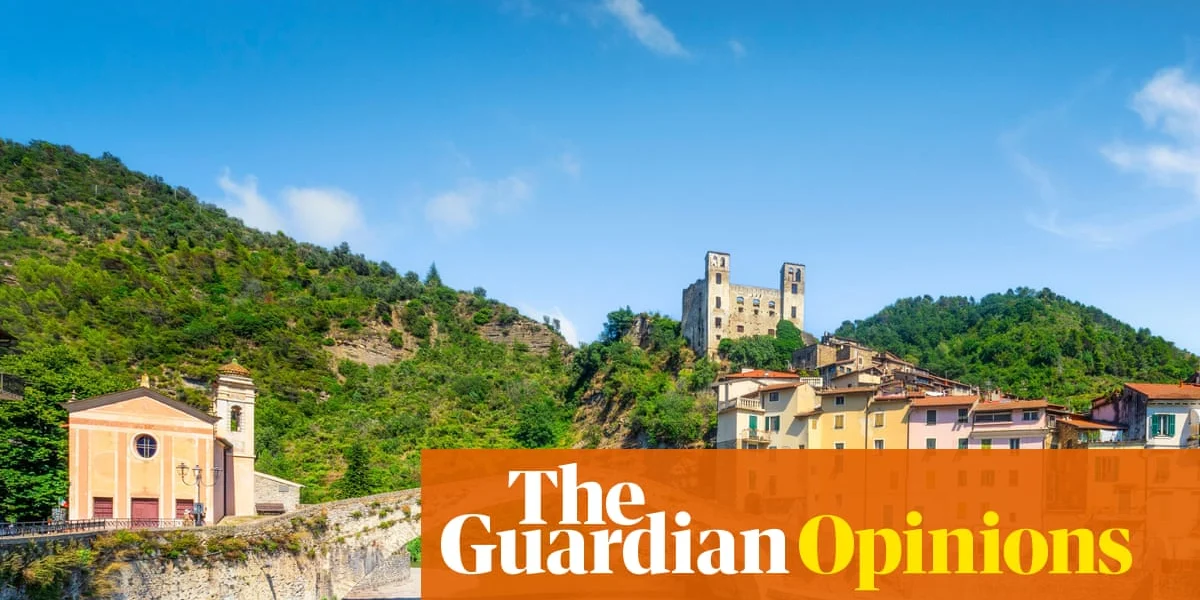
On the Riviera di Ponente, sandwiched between the glitzy resort towns of the Ligurian coast, sits the Albenga plain. Dotted with campsites and bungalows, the area developed during Italy’s postwar boom as an affordable refuge for workers to escape the smog of nearby industrial cities like Turin and Milan. While much of the surrounding coast is now given over to boutique lidos, this corner of the riviera is still a place where families gather in the shade of eucalyptus trees to play cards, share picnics and nap through the afternoon heat to the chorus of cicadas. These are the stubborn devotees of villeggiatura: Italy’s mythic, month-long summer break.
The origins of villeggiatura go back to the Renaissance, when nobles would leave their urban palazzos for gilded countryside villas in the hills, for weeks at a time. During the 20th century, however, middle- and working-class Italians made their own claim on it, transforming an aristocratic privilege into a mass ritual. By the 1960s, millions of Italians had come to consider a long summer break a fundamental right, spending holidays in ancestral villages, seaside campsites, or even company-sponsored holiday resorts. It was the era immortalised in Gino Paoli’s 1963 jukebox hit Sapore di Sale (The Taste of Salt), which celebrates “lazy days passing by” at the beach, dreaming “of a different world” beyond the factory and office.
Read more:It’s the SUV tyranny: where have all the normal family cars gone? | Coco Khan | The Guardian
There is something undeniably nostalgic about this picture-postcard image, but the politics that made it possible are worth reflecting on, not least in contrast with our own overworked age. Italy’s enviable leisure culture did not emerge from nowhere. It was the once-powerful trade unions that fought for this right, securing Italian workers some of the longest protected holidays in Europe. The forces of capital were forced to adapt. Firms like Fiat and Olivetti didn’t just shut down for most of August; they actively encouraged their employees to decamp for the summer, funding mountain retreats and seaside colonie for workers and their children. Even the state helped bankroll the long pause, offering low-cost train tickets and supporting budget holiday programmes to enable families of all classes to participate.
There are analogues elsewhere in Europe, from the English Wakes Weeks to the French villages vacances. What was unique in Italy’s postwar period was the systemic collaboration between organised labour, business and the state, and it has provided Italy with a cherished ritual that remains rooted in the national culture to this day.
Inevitably, some have bemoaned Italy’s August shutdown as the apotheosis of southern European laziness, asking how an entire country can simply pause for weeks on end. Yet villeggiatura has always possessed its own internal economic logic. During the 1960s, at the height of the phenomenon, Italian productivity grew at an average annual rate of 4-6%, higher than that of the US. Industrial output was robust, labour turnover was stable, and despite nascent protests against increased automation, urban unemployment reached historic lows. Decades on, international OECD data continues to show that longer working hours yield diminishing returns, thereby reinforcing a truth that many Italians once considered self-evident: that the right to rest sustains an economy, rather than depleting it.
The true philosophy behind villeggiatura, however, is less about economic metrics than human flourishing. In today’s Italy, where precarious employment has bred chronic insecurity, workers spend the year enduring long, erratic hours only to rush off on brief, overpriced breaks. The resulting cycle of burnout and manic consumption is, surely, unsustainable. Villeggiatura offers an alternative model. Instead of Airbnbs, it relies on long-term lets and family homes. Instead of sightseeing, it privileges sunbathing and sleep. Instead of tasting menus and overpriced cocktails, it prioritises simple rituals, like sharing focaccia and watermelon on the beach with family and friends.
On paper, this sounds like an ideal way to spend a summer. Unfortunately, though, fewer and fewer Italians are able to achieve it. Where workers were once able to decamp for weeks on end, the average holiday had dropped to 13 days by the 1990s as deregulation transformed the labour market, and the figure now stands at barely six. Last year, 35.7% of Italians reported being unable to afford even a short break away. To make matters worse, the very concept of villeggiatura is being co-opted by luxury brands. The Belmond hotel group recently published a $120 coffee table book titled Villeggiatura, explicitly appropriating the language of the long break to market hotels like Portofino’s Splendido, where a room can set you back several thousand euros a night.
Despite these pressures, Italians have not yet surrendered their ritual. Places like Albenga remain popular destinations for long August breaks, as do the traditional lidos of the Riviera Romagnola on the Adriatic coast, where, despite the spread of exclusive beach clubs, pockets of affordability still endure. Heritage groups are working to revive the physical monuments of corporate vacation spots, from the Eni village in Borca di Cadore to Olivetti’s seaside retreat in Marina di Massa. Even remnants of state support persist, like government-funded grants that allow the children of lower-income public-sector workers to attend summer camps.
For the most part, though, villeggiatura today requires far more compromise and financial strain than it once did. Many Italian workers opt for inland destinations away from the coast, where prices remain lower. Others juggle diminished workplace benefits, piecing together the limited time off their employers allow. Digital workers are perhaps the phenomenon’s most inventive contemporary adherents, with many choosing to forego pay to take time off, or surrendering some precious rest hours to answer emails from beneath a beach umbrella.
The fact that so many are fighting to keep this ritual alive against all odds tells us what is at stake here. Villeggiatura was never just about taking a holiday, but reclaiming life from the totalising logic of the market. In an era when workers across Europe are exhausted, isolated and struggling with the high cost of living, that simple idea remains quietly inspiring. Far from a relic of 60s nostalgia, or a gimmick for luxury brands, its true legacy is a defiant belief in the necessity of rest. Villeggiatura reminds us that a slower, healthier way of life should not just be an elite privilege, but a fundamental right – one that, with a dose of political will, could once again be accessible to the many.