As shock at the scale of the far right’s resounding state-election victory in Germany reverberated on Sunday, not everybody was unhappy.
Seconds after the first exit polls from Saxony-Anhalt were revealed, Donald Trump posted the results on his Truth Social platform, seemingly delighted by the devastation of the centrist-conservative Christian Democrats (CDU) and the surge of the far-right Alternative für Deutschland (AfD).
It was indeed a humiliation for the CDU chancellor, Friedrich Merz, whose party lost more than half of its seats in the state parliament, while the AfD increased its count from 23 to 39.
This was the exact opposite of what Merz promised to deliver when campaigning for office. With good government under his guidance, he insisted, he would easily cut the AfD in half. The AfD’s co-leaders did not miss the opportunity to point out the historic upset in their victory speeches, with Alice Weidel even boasting the CDU would “never win an election again”.
Read more:The deportation of Milo Yiannopoulos signals a rupture within Maga | Moira Donegan | The Guardian
Leaving the AfD’s swagger aside, this is a political earthquake with consequences far beyond a little state in the centre of Germany. The shock waves are still coming. To begin with, it is unclear if (and for how long) Merz can hold his own coalition together and cling to the chancellorship.
True, the losses in the state of Saxony-Anhalt are not directly his fault. But that is only because he is so unpopular that his own party did not want him to campaign. Merz’s face was not on any posters, and when he visited the state capital, Magdeburg, the public was carefully excluded. That says it all about his standing in his own party.
Two more elections are coming up on 20 September, in Berlin and the Baltic coastal state of Mecklenburg-Western Pomerania. On the current trajectory, the CDU is looking at two more debacles.
Merz’s leadership has become a liability, and it will be contested sooner rather than later. For now, only the absence of a convincing alternative and the many constitutional hurdles against sudden leadership changes in Germany protect him.
He is the public face of a crisis of confidence in Germany’s leadership, but he is not its sole cause. The seismic nature of this moment goes far beyond party tactics. Germany is entering a period of political upheaval in which the core values of the postwar republic are up for dispute.
Most shockingly, this extends to the anti-fascist consensus of “never again”, established over decades in many heated debates on the Holocaust and the crimes of the Wehrmacht. The AfD has managed to attack the national consensus that facing up to the Nazi past is fundamental for democracy in Germany. The party’s message is the opposite: the culture of remembrance is an “identity disorder” holding Germany back. It’s a central tenet of the AfD’s platform that it can “heal” the country by relativising its guilt and focusing on German greatness instead.
This is why Charlotte Knobloch, a 93-year-old Holocaust survivor and former chair of the Central Council of Jews in Germany, expressed “horror” about the results.
Knobloch said she “struggled, on days like these, to recognise my homeland”, adding: “In my worst nightmares, I could not have imagined that rightwing extremists win elections again in this manner.” She is right to be alarmed. The Saxony-Anhalt state chapter of the AfD is confirmed by domestic intelligence to be among the most radical nationally. Hardcore former neo-Nazis sit in influential positions.
A distinctive trait of Germany’s far right compared with France or Italy is often overlooked. The AfD is markedly different from other rightwing populist parties in Europe: it is becoming ever-more radical the closer it gets to power.
The leadership in Magdeburg employs several former members of prohibited neo-Nazi groups. These people might soon serve in high offices in the state, controlling the police, the domestic spy service (Verfassungsschutz), the judiciary and education. It’s a sign of the deterioration of political norms in my country that this shocking outlook hardly figured in the aftermath of the election. The German taboo about hard-right extremists in executive office is crumbling.
The AfD slogans against the mainstream parties (“Altparteien”) have a distinctly Weimar vibe, echoing hateful propaganda against the despised “system” from a century ago. It is no coincidence that books on the end of the Weimar republic are bestsellers these days.
The AfD is not a normal party. It must be understood as a (counter)revolutionary movement trying to change the system from within. Its leaders’ ambitions go beyond this or that policy change. Look at the crucial topic of migration: the number of asylum applications is rapidly falling (down by 48% in July 2026 compared with the same month last year), partly due to restrictive measures by Merz’s government.
Still, the hard right is growing and radicalising at the same time. At the core is the idea of a German ethnostate with as few foreigners as possible. The party’s rallying cry of “remigration” targets not just “illegals” but all immigrants (and their descendants) with unwanted foreign backgrounds.
The leadership have coined a term for what they do not want to become: they vow to avoid “Melonisierung” (Meloni-isation). Giorgia Meloni, despite her neo-fascist roots, surprised many at home and abroad by moving towards the mainstream, by standing with Ukraine and supporting the eurozone, Nato and the principle of free movement within the EU.
The AfD, by contrast, promises to leave the EU and eurozone and put an end to the Schengen agreement. It is fiercely pro-Russian and wants to cut any support for Ukraine (including sending refugees back). Fear of escalation with Russia played a big part in the election. The recent hybrid attacks on Leipzig airport and other infrastructure may have tipped the scales: Merz had pointed a finger at Russia and vowed to “make the perpetrators pay”. This turned out to be perfect fodder for the AfD’s campaign. Abandoning Ukraine, rapprochement with Russia, reopening the Nord Stream pipeline in the Baltic – all this was presented as a “policy of peace”. This is also an election win for Vladimir Putin.
What’s next? Without an absolute majority, the AFD may depend on the cooperation of a tiny splinter party. The leadership of the Sahra Wagenknecht Alliance (BSW), which broke away from the hard-left Die Linke, may want to help. They represent a new brand of leftist nationalism which is fiercely anti-immigrant and pro-Russian – and in that sense compatible with the AfD. Still, forming a government in Magdeburg will not be plain sailing. And it is a long way from this point for the AfD to take Berlin.
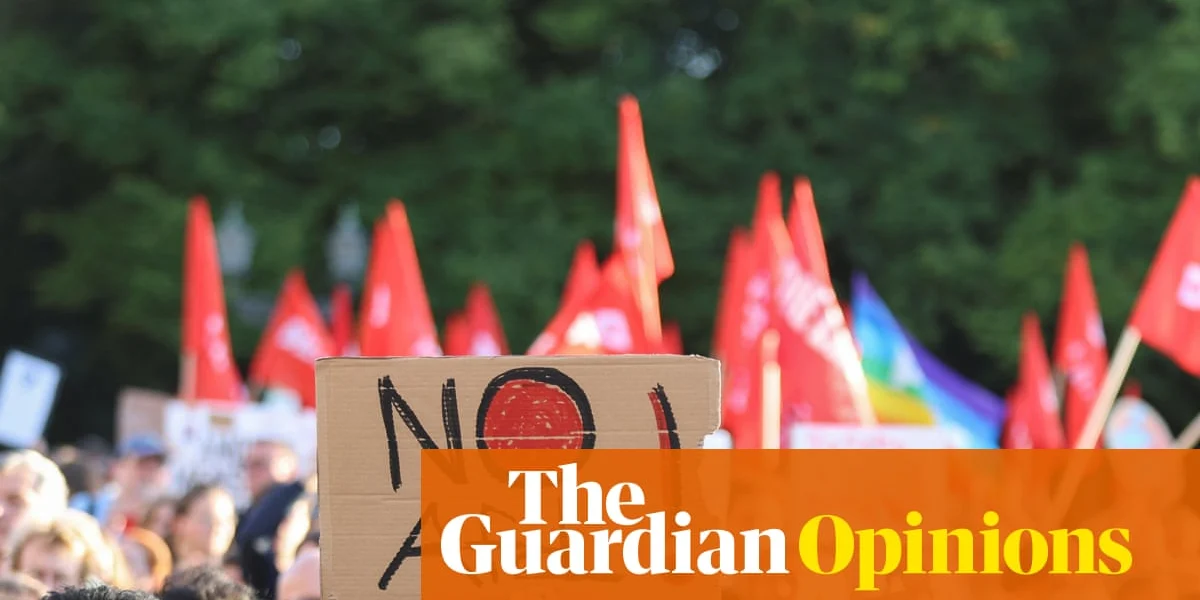
One glimmer of light is that civil society is mobilising, now the initial shock has worn off. We can expect big demonstrations in major cities. A silent anti-fascist majority is beginning to organise. But it will be hard to break the dark spell that this victory in a troubled state has cast over the political landscape in Germany.
One thing is certain: the coming weeks will be a challenge to the political imagination, not just for Germans.