


Here is a list of things: live television, color television, microwaves, radar, commercial air travel, ballpoint pens, the notion of a “tech company,” red cards, yellow cars, credit cards. … We could go on.
What do the random items on this list have in common? None of them existed the last time the U.S. men’s national team looked that good at the World Cup.
Back then, Bert Patenaude was playing for the Fall River Marksmen, a team that was not actually located in Fall River because Massachusetts still had “blue laws,” which prevented soccer games from being played on Sundays. Instead, they played across the border in North Tiverton, Rhode Island. In 1930, Patenaude scored a hat trick in the USMNT’s last three-goal win at a World Cup, in Montevideo, Uruguay.
Funny enough, it was against the same team it just happened to again on Friday, when the U.S. beat Paraguay, led by a pair of goals from Folarin Balogun.
Soccer beginner, former pro, AYSO mom, annoying person who was born in Ohio but insists on calling it “footy” — everyone could see it: the U.S. looked incredible in its 4-1 win against Paraguay to open the 2026 World Cup. But just in case you need a little context, that’s roughly the equivalent of a 20-point win in the NBA or a 23-point win in the NFL.
Though it feels like a high-water marker in the century-long, always-fledgling history of the U.S. men’s national team, how does it compare to other dominant wins in modern World Cup history? And more importantly, how much does one dominant World Cup win typically tell us about how far a team is likely to go?
Read more:Ann Patchett’s next accolade: A peace prize rooted in the Dayton Accords legacy
How good, historically, was the U.S. against Paraguay?
For as ephemeral and complex as it might seem, there are really three main phases of soccer that both teams are battling to achieve: controlling territory, progressing the ball into dangerous areas and creating chances.
For the first, we can look at field tilt, which is the standard possession stat you see whenever you watch a game, but adjusted to only account for the final-thirds at each end of the field. Against Paraguay on Friday, the U.S. produced a field tilt of 80.5% — at the time, the fourth-highest mark by any team in their opening World Cup match since the tournament expanded to 32 teams in 1998.
But even that slightly undersells how rare this level of territorial dominance actually is. When it comes to all-time dominant opening World Cup matches, two of the teams ahead of the U.S. — Spain in 2010 and Argentina in 2018 — did it in matches that they didn’t win. And both Switzerland and Türkiye just did it in this tournament — in matches they didn’t win.
In other words, all of these other teams tilted the field against opponents that were happy to let them do it — but the Americans did it against a team that was losing for 90-plus minutes of game time.
Of course, just because you can keep the ball down at the other end doesn’t mean you’re able to move it into truly dangerous areas. The penalty area is the most valuable area on the field because, well, it’s close to the goal — but also because it requires defenders to play differently since a foul suddenly becomes a penalty kick.
Read more:Vitamin A overdoses on the rise: Experts answer 5 key questions
And, well, only Spain in 2010 generated more touches than the 54 by the U.S. against Paraguay — until Germany got 64 in their win against Curaçao on Sunday. And again, the Americans stand out because they actually won — before 2026, the highest tally for a winning team was France‘s 44 against Australia at the last tournament in 2022.
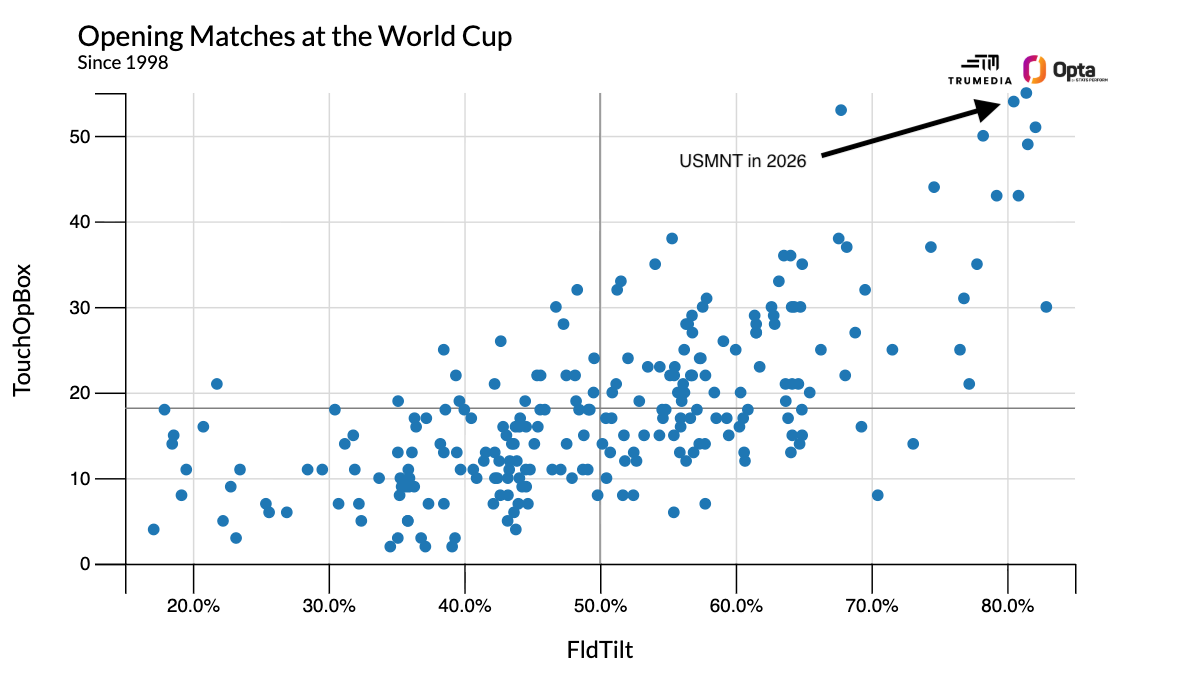
Obviously, none of that matters if you (A) can’t consistently turn the dangerous possession into actual chances, and (B) can’t prevent your opponent from counter-attacking. The U.S., of course, did all of that, too. The Americans scored four goals and had another disallowed. They conceded only nine shots, which had a combined conversion probability of 0.53 expected goals.
In Mauricio Pochettino, the U.S. hired a successful club manager with a history of building high-pressing teams with aggressive midfield runners, and that’s exactly what we saw Friday.
Per the data company Futi, the U.S. made 112 high defensive actions in its opening match — 20-plus more than any other team so far. And aided by the constant off-ball movement from midfielder Malik Tillman and Weston McKennie, the Americans ripped apart Paraguay whenever they gained back possession. They won 122 phases of possession, per Futi, which means they increased their goal-scoring probability in 122 different situations — the fourth-highest mark of any team after one match.
So, does this mean the USMNT can win the World Cup?
Doesn’t the last World Cup show us that the first game doesn’t really matter? You know, the World Cup in which Lionel Messi and Argentina won the whole thing despite losing to Saudi Arabia to open the group stage?
Read more:Ebola outbreak: Top 3 questions about spread, outlook, answered
The point resounds even more strongly if you flip it around: Saudi Arabia beat Lionel Messi and Argentina in their opening game of the 2022 World Cup, and they still didn’t even get out of their group.
The same was true in that aforementioned game from 2010: Switzerland beat Spain 1-0. Switzerland didn’t get out of the group. Spain won the whole thing.
It’s so easy to get sucked into reading too much into the meaning of one game at the World Cup — despite soccer being so random that, as I wrote about last week, one NASA scientist wrote a paper that condemns the 90-minute match as a “poorly designed experiment.” But it’s just as easy to write off one game as meaningless because we’ve also seen similar games be meaningless before.
Instead, let’s take a look at all of the games together to see if we can glean some larger meaning from a first-game blowout.
To do so, we’re going to use a stat I call “adjusted goals” — it’s a blend of expected goals (xG) and actual goals with 70% weighted toward the xG.
Read more:Which players have scored a hat trick in the World Cup?
This stat has proved to be more predictive of future performance than xG, and it also doesn’t punish teams who go up early and take their foot off the gas. At the same time, it awards teams who build up a lead and keep creating chances. In other words, it tells us which teams dominated in chances created, and in chances converted into goals.
Against Paraguay, the U.S. produced an adjusted-goal differential of plus-1.52. That’s the 33rd-best mark in a World Cup since 1998.
But we’re going to expand it out to the 49 teams who have generated an adjusted GD of plus-1.3 or better. We then have to remove the U.S., along with South Korea, Mexico, Switzerland, Germany, and Sweden from the current tournament, so that leaves us with 43 teams to hit the plus-1.3 threshold.
Of those 43 teams:
• Four won the World Cup
• Four reached the final
• Eight reached the semifinals
• 12 reached the quarterfinals
• 11 reached the round of 16
• Four were eliminated in the group stage
Since chance-creation dominance is the most important thing — and the most predictive thing for future performance — tilting the field and controlling penalty-area penetration make that chance creation itself more repeatable.
Read more:2026 World Cup: Patrick Mahomes, Jay Z headline celebrities
Though you can create better chances than your opponent by sitting back and letting them camp out in your penalty box, that requires an incredible level of efficiency, both in converting your handful of final-third possessions into good chances and limiting your opponent over and over again. Pinning the ball in the other team’s third and constantly breaking into the penalty area simply shifts the odds in your favor.
None of the four teams who were ultimately eliminated from the group stage were able to hit any of the other possession-dominance markers that the U.S. did. If we look at teams with dominant adjusted goal differentials, plus at least 60% field tilt and at least a plus-20 advantage in penalty-area touches, there have been 11 teams since 1998 who did it in their opening-match victory, along with the U.S. and Germany from 2026.
All of them made it out of the group, five of them made it to the semifinals or better, and eight reached the quarterfinals.
Of course, there are all kinds of complicating factors with this analysis. The biggest one: the quality of the opponent you get drawn with in your first match.
But to put it in a way that will allow U.S. fans to let their expectations run wild: teams that have dominated their opening games — around the goal, inside the box, and across the field — like the U.S. team just did? They’ve made it to at least the quarterfinals more than two-thirds of the time.