
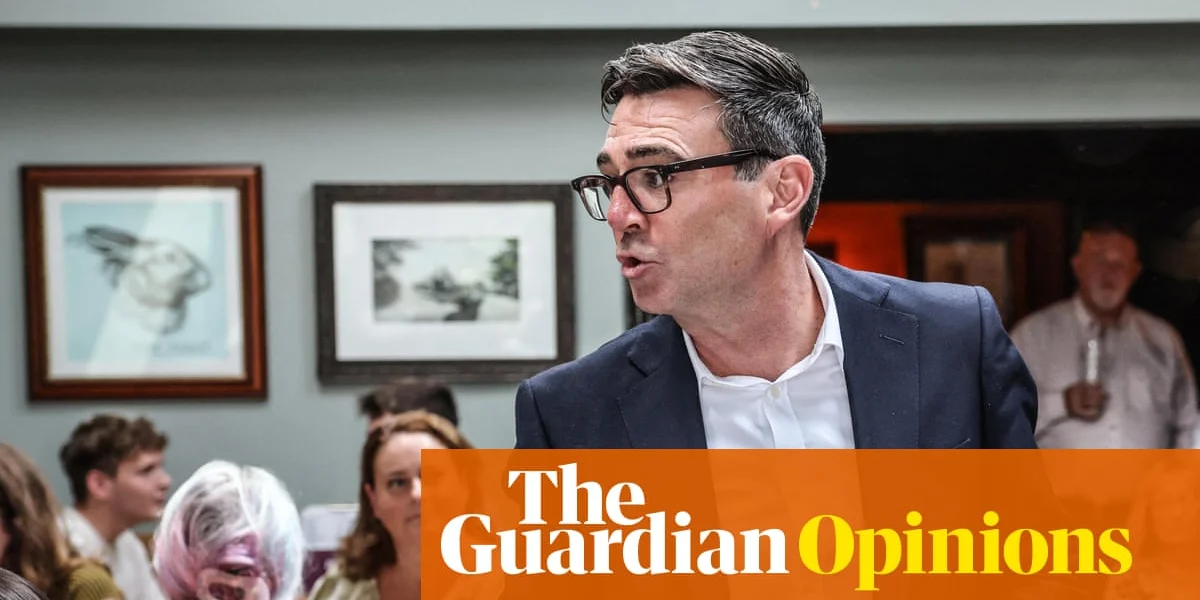
Who are we, the people Andy Burnham now governs? He inherits a miserable lot: grudging, angry pessimists, expecting the worst of all politicians, trusting no one to lead the country well, according to a long-running study. British folk feel the social contract is broken, they feel let down. Ignorant of basic facts, they are wilfully misled by malevolents.
Over half a century of taking their pulse, Ipsos has collected data on shifting attitudes for the mighty Understanding Society, the largest longitudinal household study in the world, run by the Institute for Social and Economic Research. By chance, this latest national portrait will be the benchmark for Burnham’s era. Here are his people: can he make them feel better? In the end, that’s the great purpose of all politics: you can have good policies, make improvements, do your honest best, as Keir Starmer tried, but if you don’t make the people feel it, then it’s a sounding brass or a tinkling cymbal, as Paul told the Corinthians. Can Burnham lift up their hearts, a bit?
Reading this survey, he may sink his head in his hands. Earning any trust is a Himalayan climb: it was bad enough back in 1989 when just 33% believed politicians were good people in general, but now that’s fallen to 20%.
The people’s contradictory desires are many: they want lower taxes and better services – a higher standard of living without paying for it. They admire Sweden above all other countries, yet show little sign they would accept Swedish taxes at 42% of GDP, while ours are about 33%.
Impossibilism is everywhere. Launching the report, Gideon Skinner, Ipsos’s director of UK politics in public affairs, said: “We are seeing a sharpening public friction between high expectations for public services like the NHS and a declining appetite for the taxation required to sustain them.” Belief in the welfare state remains high, but it has slipped. The old divide between collectivists and individualists has deepened: “a society which emphasises the social and collective provision of welfare” gets 46% support, fallen from 54% in 1989, while 47% now want “a society where the individual is encouraged to look after themselves”, compared with 40% in 1989.
Read more:Could the new limit for human life span be 190 years?
But people are contradictory, torn between public spirit and private greed. Asked if they would prefer “a mainly socialist society in which public interests and a more controlled economy are most important” or “a mainly capitalist society in which private interest and free enterprise are most important”, support for socialism has risen to 57%, which is 10 percentage points higher than in 1989. More people now support “a society which emphasises similar incomes and rewards for everyone” than in 1989. What does that mean and how can Labour seize on those sentiments, not the meaner impulses?
People see some glaring truths – they are not hoodwinked by the Americanised myth that everyone can make it if they only try harder. “Belief in social mobility has halved since 1989”, as only one in four (26%) now believe that the best people rise to the top regardless of their start in life, down from 52% in 1989. The facts show how birth and inheritances are cementing future chances.
Pessimism is at its worst in 50 years and 72% expect a world war within the next 25 years (many more than at the height of the cold war in 1983). And yet people are not unhappy: “The clear majority of Britons remain happy with their life at present, even if fewer are ‘very happy’ than in 1991.” Live-and-let-live liberal values have made the country more tolerant since the 1980s.
Yet here’s the alarm sounded by Ipsos. “This moment feels different in character to the cycles of political dissatisfaction we have seen before,” Gideon Skinner warns. “What is worrying is that pessimism risks becoming more embedded in Britons’ sense of national identity.”
People may be less despairing if they knew the basics of the social contract they think is broken. Wild misunderstanding of what they pay in tax and what they get from the state fuels resentment of government. The political psephologist Peter Kellner, poring over the Office for National Statistics’s treasure trove “Effects of taxes and benefits on household income”, finds that 53% of the population gets back more from the state than they pay in: that includes not just all taxes and VAT, and cash transfers in benefits and pensions, but non-cash benefits such as the NHS, social care, education and transport subsidies (omitting collective benefits, such as the police and the armed forces).
But very few know it: only 12% think they get more than they pay in. Very few over-65s recognise the ONS calculation that 90% of them gain more: even those on incomes over £70,000 on average get more than they pay, mostly because of how much they use care services and the NHS. Everyone needs a well-funded state, the old most of all, yet they vote against it.
Read more:Here’s how Andy Burnham really could end homelessness | Daniel Lavelle | The Guardian
That’s the ignorance and the ingratitude Burnham faces. When he says, “Let’s build a new national sense of unity, of common purpose and positivity,” it needs a burst of public education to counter the daily blast of bad-faith misinformation from the right and its media. Ignorance is inexcusable when it has never been easier to find out anything at the click of a mouse.
Starmer and Rachel Reeves tried to square with the people, telling brutal truths about hard choices and high debts. The people hated it. That’s Burnham’s template for what not to do. But how does he revive faith in the state? He starts with small goodwill gestures to show the government is there to help – with cuts to electricity bills, bus fares, tax for state pensioners, and business rates for pubs and clubs. Saving music venues chimes with his aim to change the mood of the nation. The public’s demand for urgent change is no guide: it points chaotically in contrary directions. Good leaders seize on guiding the better parts of human nature to believe things can be better.