

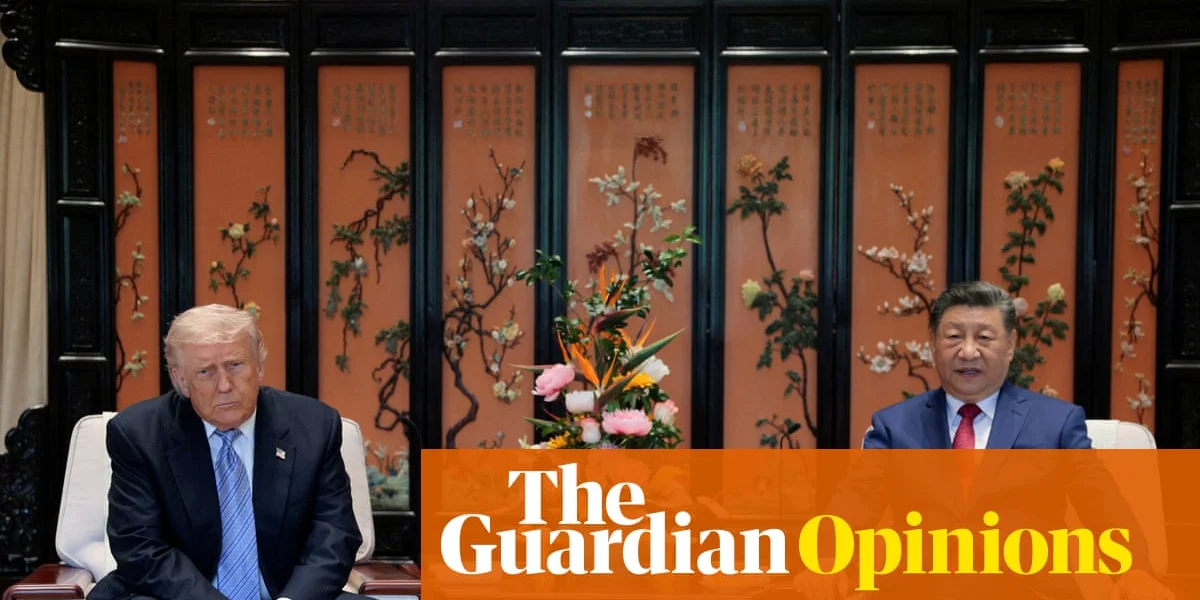
America is in decline. And so is Pax America: the American-led world order. While there are many genuine dangers of American decline, there has never been a better chance to say clearly how much the unipolar order always left to be desired, and to imagine a multipolar world that might secure peace better than the old order ever did.
Idealizing the American peace since 1945 and its “rules-based international order” – a phrase that came into common use only decades later, but never mind – is a misguided response to our current situation.
The dominant response has been a futile effort to get the good old days back: liberal commentators mourn the fact that Atlanticism is under threat, and issue sentimental defenses of lost multilateralism, and, often enough, a hankering for morally uplifting wars to wage.
When charged with idealizing the past, these nostalgists retreat to a defense of useful illusions: yes, the old order lied, but at least it lied in the name of ideals.
The speech by the Canadian prime minister, Mark Carney, at Davos in 2026 was greeted in some quarters as daringly honest for saying aloud that, at least for great powers, the old talk of ideals and rules had always rested on a pleasant myth. But that was hardly news.
And Carney was wrong to suggest that the lie had once made the world better. Few outside the Atlantic core ever mistook Pax Americana for the best of all possible worlds. Carney soon exposed the limits of his own candor when, only weeks later, he publicly supported Trump’s war of choice against Iran.
The old order of high-minded hypocrisy was never good enough for the global south; it was not simply ruined by a president offering too raw a deal.
More important, the conventional responses to our moment are not only unconvincing and undesirable; they are also unavailable. That is a good thing.
Read more:Wrexham sign Danny Imray from Crystal Palace; Paul Mullin joins Rotherham
Instead of trying to revive a flawed and morally bankrupt former world order, the current moment calls for an antiwar agenda suited to an inevitably plural and rivalrous world.
An antiwar agenda for this world should begin with four commitments.
First, states should reaffirm and strengthen limits on the right of self-defense they can claim under article 51 of the UN Charter.
Second, states should recommit to the inadmissibility of annexation or territorial acquisition by force (including de facto annexation, as in Israel/Palestine today).
Third, great and middle powers should commit not to instigate, enable or intensify proxy wars against one another.
Fourth, states should neither furnish military assistance nor allow arms sales that predictably abet gross violations of rules against aggression or atrocity.
The virtue of such a bargain lies in its thinness. It does not ask states to agree on the whole architecture of world order, or to share a moral vocabulary.
It asks those who join to accept one clear, narrow and urgent proposition: no state is safer in a world in which coercion is unconstrained because every exception claimed by one power becomes available to its rivals.
Read more:Spain World Cup champions return home for a royal welcome, parade
This bargain also answers the most obvious danger of the emerging order. Trump’s foreign policy shows how an American hegemon in decline may help produce an even more violent order than the one that has prevailed since the end of the cold war.
But that danger should not lead internationalists to pine for restored unipolarity under better liberal management (let alone the same crew of liberal internationalists). Multipolarity also creates an opening.
If no single power can plausibly claim to enforce rules for everyone else, then an order based on mutual restraint may prove more stable than one built on a hierarchy that no longer commands belief.
Reviving the antiwar norm requires more than a restoration of the mid-century compact, though it should begin from some of the insights that were clear to the original architects of the postwar order.
Reciprocity need not entail moral equivalence between aggressor and victim, nor does it require indifference to atrocities.
But it does require enlightened self-restraint, meaning that states must be asked to accept rules they would also want applied to their rivals, their allies and themselves.
A restraint bargain framed in this way has advantages. It addresses the charge of hypocrisy more directly than appeals to an older order whose enforcement was systematically uneven.
It also gives rival powers a reason to comply even when they do not share a common political project.
Every major and middle power is less secure in a world where preventive war, annexation, proxy conflict and coercive strangulation are normalized tools of statecraft.
The last quarter century has vividly demonstrated this reality through the global costs of the so-called war on terror, as well as Russia’s war against Ukraine and the US-Israeli war on Iran.
These costly wars of choice illustrate an argument for restraint grounded in self-interest, rather than virtue.
Our four points provide the details of a newer world order.
First, states should reaffirm and strengthen limits on the right of self-defense they can claim under the UN charter. The right of self-defense was never meant to be a general license to attack on the basis of speculative future threats, degraded deterrence, or broad claims of regional danger.
The distinction between defense against an imminent attack and preventive war is essential. Once that distinction collapses, every rivalry can be redescribed as a security emergency and every powerful state can claim the right to strike first.
Likewise, states must oppose other interpretations of self-defense, such as the noxious doctrine that self-defense permits attacks on the territory of states “unwilling or unable” to control non-state actors on their territory.
Read more:US negotiator Brett McGurk will release a book on the Hamas hostage crisis
Second, states should recommit to the inadmissibility of annexation or territorial acquisition by force, including de facto annexation accomplished through occupation, settlement, demographic engineering, or the creation of irreversible facts on the ground. This principle is one of the clearest tests of whether multipolarity will be governed by mutual restraint or by regional domination.
A world of spheres of influence is, almost by definition, a world in which weaker states’ territorial integrity becomes negotiable, as US threats against Venezuela, Cuba, Greenland and even Canada have made clear.
The implications for any prospective resolution to Russia’s war against Ukraine are obvious.
Third, great and middle powers should commit not to instigate, enable or intensify proxy wars against one another. Defensive support to a state resisting aggression is one thing; measures designed to prolong war or turn a local conflict into a means of bleeding a rival are quite another.
Proxy conflict is one of the main ways in which formal adherence to the charter coexists with escalating violence. It allows states to deny direct responsibility while sustaining conflicts that devastate civilian populations, destabilize regions and increase the risk of wider war.
Fourth, states should not furnish military assistance or permit or sponsor arms sales that predictably abet gross violations of rules against aggression or atrocity. When outside powers arm and shield partners engaged in aggressive war or mass civilian harm, they help convert local or regional wars into tests of global alignment, as the wars in Gaza and Ukraine have illustrated.
The limits of nostalgia are nowhere clearer than in the old “rules-based” order’s failure to interdict or regulate the trade in conventional weapons. World military expenditure reached nearly $2.9tn in 2025.
The international market in major arms is also highly concentrated: in 2021–25, the United States accounted for 42% of global exports, and the five permanent members of the United Nations security council together accounted for nearly 68%.
A robust agenda on this front could build on the Arms Trade Treaty, which prohibits transfers where a state knows that the arms would be used to commit genocide, crimes against humanity, grave breaches, attacks on civilians, or other war crimes, and requires denial where there is an overriding risk of specified serious violations.
That framework should be extended to arms transfers foreseeably facilitating aggression, annexation or other non-defensive force.
The point of this agenda is not to settle the entire future of international order in advance. It is to begin where agreement is most necessary and where evasion is most dangerous: no preventive war dressed up as self-defense, no annexation by force, no proxy war conducted through other people’s countries, and no arms transfers that knowingly feed aggression or atrocity.
Far from being utopian demands, these are the minimum conditions for a world in which rival powers can compete without making war the normal instrument of politics.
Multipolarity must be understood as more than a fall from the American order into disorder. It could become a scramble for domination if the strongest states are left to carve up regions, arm clients and rename coercion as security.
But it also creates a chance to build an order less dependent on one power’s virtue, less compromised by selective enforcement, and less vulnerable to the nostalgia that mistakes yesterday’s hypocrisies for lost law. The task now is to stop mourning the old order, refuse the new lawlessness, and make restraint the thin, hard core of whatever comes next.