

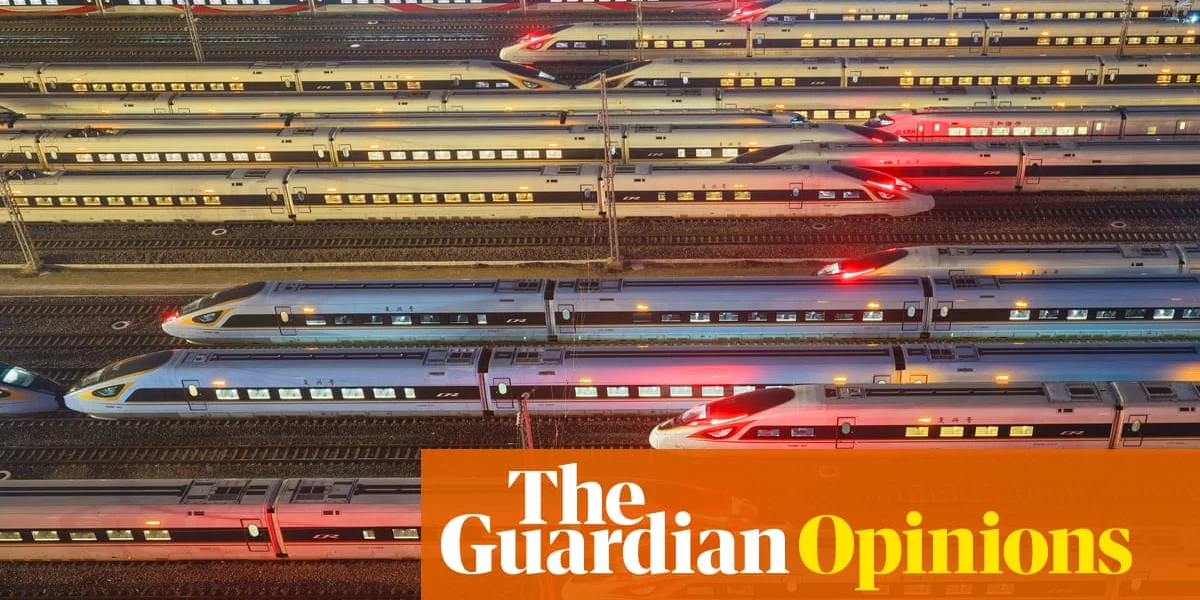
With all our grumbling about trains – and it is close to a national pastime – it is easy to forget the successes. There is a tale to tell, for example, about high-speed trains, that goes beyond the endless wrangling over HS2.
If you look at the history around the globe, as I have, you find that high-speed trains saved the railways. An industry that was gradually sinking into oblivion, thanks to motorways and aeroplanes, has been revitalised by a technological revolution that means trains travel faster, more safely and more comfortably.
Over time, beautiful but inefficient steam engines and their dirty diesel successors have been replaced by sleek modern trains that shrink distances and provide a service that their rivals on either land or in the air cannot compete with. Train travel that had been in decline has become the preferred mode of transport for many journeys previously dominated by aviation.
But this is a revolution that almost didn’t reach Europe. In 1964, Japan became the pioneer, creating the Shinkansen, known worldwide as the bullet train, in effect the first motorway on rail, with dedicated tracks, a small number of stops and an at the time unprecedented top speed of 210 km/h (130mph). Nowadays trains often run at 190mph and they may routinely reach 250mph before the decade is out.
But as Japan surged ahead, 1960s Europe had fallen out of love with trains. Beeching-type cuts were the order of the day across the continent and a new invention seemed in the 1980s to be about to supersede the iron road. This was levitation technology, with trains being elevated by air or magnetism and pushed forward at great speed by rocket propulsion or magnets. Tests in France of the Aérotrain saw it reach speeds of almost 270mph, while the German government was promoting maglev technology, funding a line running between Hamburg and Berlin.
Read more:Lionel Messi back in training with Inter Miami after World Cup
Trains were 19th century, it was said, while maglev was a technology for the 21st. But then, just as with the hyperloop, Elon Musk’s recent failed reinvention of the maglev technology, the plans for maglev fell apart, as costs soared and the practicalities of developing a whole new system running into crowded city centres proved insuperable. A 2006 disaster on the German test track killing 23 people put paid to any hopes of reviving the idea.
This victory of the railways over its rivals guarantees that trains will be operating across the world in the 22nd century. The victory by rail meant high-speed rail systems emerging first in France and then across Europe in Germany, Italy and Spain. In addition, 25 countries in the rest of the world, ranging from Morocco and Turkey to Taiwan and Uzbekistan, have high-speed rail systems or are developing them.
Read more:Former England manager, Liverpool great Kevin Keegan dies aged 75 after cancer diagnosis
The rewards are great, but the subject is always controversial because the route to high-speed rail is never easy. These are megaprojects costing sums with more zeros than any other government projects except possibly defence and space travel, and to see them through needs consistent government support, a clear understanding of their purpose and a long-term budget.
In all the high-speed rail schemes across the world that I examined for my book, it was a struggle to find any that were completed on time and on budget. Most achieved one of these – the UK’s HS2 and the California high-speed project being the exceptions, failing miserably on both counts – and by and large they have been successful in attracting passengers and in many cases seeing off domestic flights on their routes. Who now flies between London and Paris, or indeed Barcelona and Madrid, or Rome and Milan? Mostly only people who are interlining, that is, transferring to another flight. The sensible choice for most people will usually be a pleasant train ride with fewer security hurdles to overcome and city-centre to city-centre travel.
Read more:AI-assisted staging draws boos at the Richard Wagner festival in Germany
New high-speed lines have generally been designed to relieve congestion on the busiest existing railway routes, such as Paris-Lyon or Tokyo-Osaka. But high-speed rail has also been used as a catalyst for a wider modernisation scheme, notably in Spain, which surprisingly has Europe’s most extensive high-speed rail network, with about 2,500 miles of line, as a result of a clear government strategy to use trains to create better connections between regions and the capital, Madrid. The Spanish government, noting the success of its initial line built for the Seville Expo between Madrid and Seville, then embarked on a national programme that revived a dying rail system and changed the image of the country from a poor relative of its European counterparts to that of a self-confident, dynamic nation. High-speed rail can help do that.
But for the world leader, look to China which has built 70% of the world’s mileage of high-speed lines in under 20 years. The figures are so extraordinary that they seem almost unbelievable. There are now about 31,000 miles of high-speed line with about 10,000 services carrying an average of 10 million people daily.
Read more:OpenAI film ‘Artificial,’ dropped by Amazon, finds a new home with Neon
Here, too, though, it is more than just a railway. The officials I talked to while travelling around China on its stunning network were clear about this. Many of the early lines were built between the largest cities but now the system, which they hope to increase by at least 10,000 miles by 2040, is being expanded to smaller towns and cities to create a genuinely national network. This remarkable project is seen as a way of uniting the country in the same way the railways in Germany and Italy created nations out of these fragmented countries in the 19th century.
That was the original concept in the UK when HS2 was first conceived and its progenitor, Andrew Adonis, registered HS3, HS4 and HS5 as companies. We can but dream that this will ever be realised. For the story of high-speed rail I found was of go-ahead nations embracing the future, while others, including alas Britain, are being left behind.