

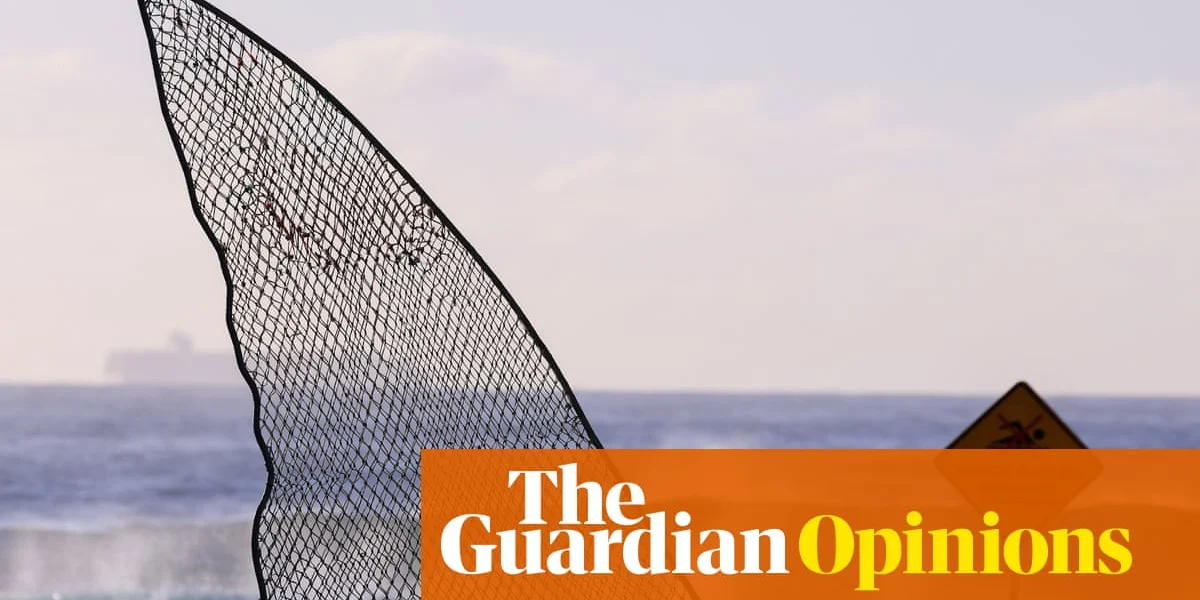
Is there a more primal fear among beach-goers than the shark? Although many more Australians drown each year at the beach than are killed by these creatures, it’s sharks that inhabit the jagged edges of our collective consciousness.
After a terrifying spate of bites earlier this year, calls for shark culls resurfaced. Ocean swimming and surfing didn’t seem quite the same healthy pursuits they had just months earlier.
The Australian Shark Incident Database registers growing numbers of dangerous shark interactions in recent years. Anecdotal evidence also suggests an increase in unreported encounters. But no one knows exactly why.
Archives reveal sharks have been a figure of fear and fascination throughout the human history of this continent. Western Australia’s Murujuga rock art site dates back tens of thousands of years and includes depictions of hammerhead and tiger sharks.
On the other side of the continent, on the cliffs overlooking a First Nations fishing spot known as Murriverie, near Sydney’s Bondi beach, engravings also depict shark motifs. One, stretching eight metres across the sandstone outcrop, angles towards an ancestral or human-like figure and is thought to depict a shark attack.
Early Europeans also noted the dangerous presence of sharks. William Dampier gave the name Sharks Bay to that part of the west coast in 1699 after being struck by their “abundance”. When the First Fleet arrived in 1788, officer Watkin Tench noted “sharks of a monstrous size” in Sydney Harbour.
Early news reports catalogued the terror colonists felt. One article in the Sydney Gazette in 1807 reported an attack by a “voracious” shark on a swimmer in Cockle Bay which grabbed him by the arm before letting go.
An article from 1812 described an enormous shark that was dissected to reveal an entire pelican inside.
More famous was the tiger shark caught alive off Coogee beach in 1935, which, after a few days of captivity, regurgitated a tattooed human arm. Sydneysiders were aghast, but tests revealed the arm belonged to a murder victim and had been severed and dumped.
At the turn of the 20th century, the growing popularity of surf-bathing also meant an increased risk of shark encounters. While the government recommended surf lifesaving clubs be supplied with first aid kits, swimmers were essentially responsible for managing their own safety.
A spate of shark incidents in the 1920s changed all that. In Sydney in 1922, there were two fatal shark attacks in one month, and then another 13 at beaches in Sydney and Newcastle from 1924-34.
This amounted to an average of just one shark attack a year, as the NSW Shark Menace Advisory Committee pointed out. But the public were panicking nonetheless.
The state government initially resisted large scale shark mitigation, offering rewards for shark captures and advising beach-goers to avoid “bathing at dangerous hours, in isolated places, and going too far out”.
Some local councils adopted their own measures. In Coogee, enormous steel cables and nets were strung from the middle of the bay, cordoning off a large section of the beach. Swimming nets were also built at other protected beaches in Sydney, Port Phillip Bay and Perth.
Read more:Rebel Wilson cleared of defaming an actor who starred in her directorial debut
Other proposals suggested shark baiting and bombing, giant curtains of bubbles, concrete barriers, or electric fences, but each was rejected for being impractical or untested. By the mid-1930s, however, after further attacks in Sydney, the principal recommendation was for the “systematic meshing” of the city’s beaches.
The nets wouldn’t be full enclosures but set parallel to the shore to catch and kill sharks. With no attacks in the following decades, meshing was extended to beaches in Newcastle, the Central Coast and Wollongong. In the 1960s, Queensland also adopted a strategy of beach nets and baited drum lines.
There wasn’t huge opposition to these safety measures through the middle decades of the 20th century. Public sentiment largely held that a good shark was a dead shark, and big game fishers took up the challenge of catching monster sharks.
Read more:Artist Betye Saar, whose work reflected Black identity, has died at 99
Over time, however, the consequences of these strategies became clearer: shark mitigation and fishing were affecting entire ecosystems. Their efficacy was now thrown into question.
Scientists pointed out the importance of apex predators such as sharks as keystone species, critical to the health of marine ecosystems, yet several are critically endangered. As more research was conducted, the language around our interactions also changed, from shark “attacks” to “incidents”.
Meanwhile, public responses to recent shark encounters show how that shift towards conservation can be unsettled by fear. Politicians find themselves weighing up scientific evidence and public safety, but in the absence of robust data that tension will only continue.