

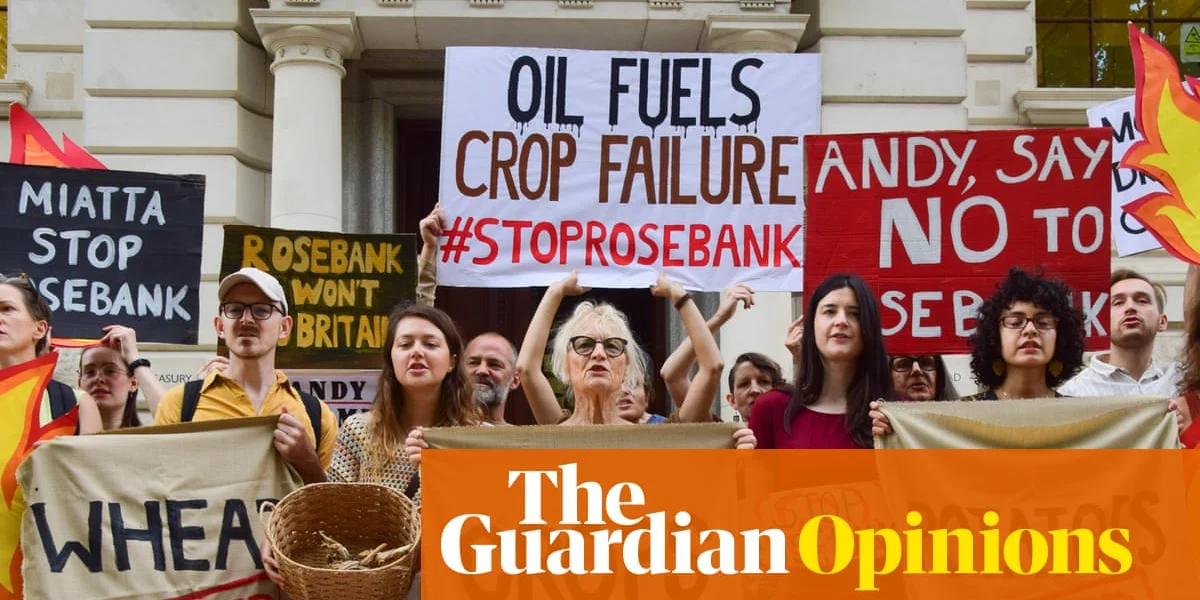
The British government must soon decide whether it should give consent to two oil and gasfields, Rosebank in the North Atlantic and Jackdaw in the North Sea. Amid both insecurity of energy supplies and deadly evidence of the climate crisis, the prime minister, Andy Burnham, is facing pressure from the oil and gas industry and unions on one side, and environmentalists on the other.
Labour’s manifesto commitment not to approve new drilling licences offers little help, because the fields already have licences, granted by the previous Conservative government in 2022 and 2023. But last year, Edinburgh’s court of session ruled that the environmental impact assessments on which this decision relied were unlawful. The Conservative government had, the court ruled, failed to include the emissions generated when the oil and gas from the fields is burned. The court allowed work to continue on the fields, but a new assessment had to be done and approval sought again.
The issue facing the new energy and climate secretary, Miatta Fahnbulleh, is whether the additional information on the fields’ global emissions alters the grounds for consent.
Although invariably discussed together, the two fields are very different. Jackdaw is a small gasfield, with a production life of only 11 years. Its total carbon emissions will be only around 24m tonnes. Annually this would equate to around 0.8% of the UK’s total emissions. The gas would be piped into the UK, so would be consumed domestically. As this would probably displace dirtier liquified natural gas (LNG) imported from the US, it would make a small contribution to the UK’s energy security and emissions reduction.
By contrast, Rosebank is a large oilfield, with a 25-year life. During that time it would generate around 250m tonnes of carbon emissions. The oil would be sent to the Netherlands for refining, since the UK no longer has the appropriate capacity – and very little, if any, is likely to be used in the UK. So it would not contribute to our energy security.
There are good reasons, therefore, for the government to make different decisions on the two fields. Jackdaw can be justified (just) on energy security grounds. The UK needs gas over the coming decade, and there is a benefit to a little more of it being domestic. Jackdaw will stop generating emissions in 2037-2038, when the UK, and the world, will still be well above net zero.
Rosebank, by contrast, will still be producing oil in 2050, when the UK is legally obliged under the Climate Change Act to achieve net zero emissions. Indeed, by 2050, the Paris agreement (which forms the bedrock of the UK’s international commitments) expects the entire world to be just a decade or so off achieving net zero emissions. For that reason, the International Energy Agency expects global oil demand by that date to be lower than today and falling, if governments around the world follow their own stated climate policies.
Read more:Brazil’s legendary Maracanã stadium to host ’27 Women’s World Cup final
Jackdaw is frankly too small to have any meaningful impact on global supply and demand in the decade it will be producing. But because of its size and longevity, the same cannot be said of Rosebank, which between 2040 and 2050 will be making a material contribution to global oil supply just when the market should be starting to decline. The greater the supply, the lower the price, and the higher the demand. So Rosebank has implications for both global emissions and international climate change policy.
Rosebank could be given consent while avoiding these consequences if the government required it to pay for some or all of its emissions to be captured and stored in disused oilfields or saline aquifers. Most of Rosebank’s emissions will occur when its oil is burned. So, making carbon capture and storage (CCS) a condition of its licence would effectively mean requiring it to pay to capture and store the equivalent volume of other producers’ emissions.
Though controversial, CCS is a proven technology: one of Rosebank’s owners, Equinor, has been using CCS in its Norwegian Sleipner field since 1996, is reported to have stored over 20m tonnes of CO2 without leakage. The UK government’s own CCS programme, operated by the North Sea Transition Authority, has now licensed 21 CCS projects at different stages of development. But Rosebank is not one of them.
The oil and gas industry has yet to acknowledge that its production can ultimately only be consistent with net zero emissions if it uses CCS. Giving consent to the Rosebank field on condition that it pays for its emissions to be captured and stored – say, from 2035 onwards – is the only way to make it compatible with the UK government’s domestic and international climate change commitments. By joining the UK CCS programme, Rosebank would probably be eligible for government support.
The additional costs of CCS might mean that Rosebank’s owners would decide not to go ahead with it. But this would merely demonstrate that the project cannot in practice be undertaken in a way that is consistent with the UK’s net zero commitments.
It is also critical that for both Jackdaw and Rosebank the government insists on strict methane limits. Methane is a more potent greenhouse gas than carbon dioxide and both fields will have significant emissions.
The government should make two other announcements at the same time. The first is to secure thousands of jobs by accelerating the labour-intensive decommissioning of oil and gasfields in the North Sea. At the same time, the government should publish a net zero transition roadmap, explaining how the UK will “defossilise” its economy over the next 25 years.
Rosebank’s and Jackdaw’s operators say they will create around 3,500 jobs in development and around 880 in operation. These are not negligible, but they will not save the oil and gas industry or the wider economy of north-east Scotland. Between 2013 and 2023, jobs in the sector fell by more than half, from 441,000 to 213,000. This has nothing to do with UK climate change policy, but is simply the inevitable consequence of the exhaustion of the British North Sea basin (around 90% of the UK’s oil and gas has now been extracted).
With around 1,700 wells due to be plugged and abandoned in the next six years and 500 already overdue for removal, decommissioning is a huge task. It will create many more jobs than drilling would (it is estimated that decommissioning will generate up to 25,000 UK jobs over the next decade and deliver about £6.8bn in economic benefit).
A net zero transition roadmap would cover both the anticipated technological pathways in energy, transport, industry and agriculture, and the implications for businesses and households. Such a roadmap would reassure firms, unions and consumers concerned about what the net zero goal really means, and deprive the media and opposition parties of the chance to speculate wildly about its costs.
It would give investors much-needed certainty. France has already produced such a roadmap, and other countries are also committed to doing so. Britain should join them.