

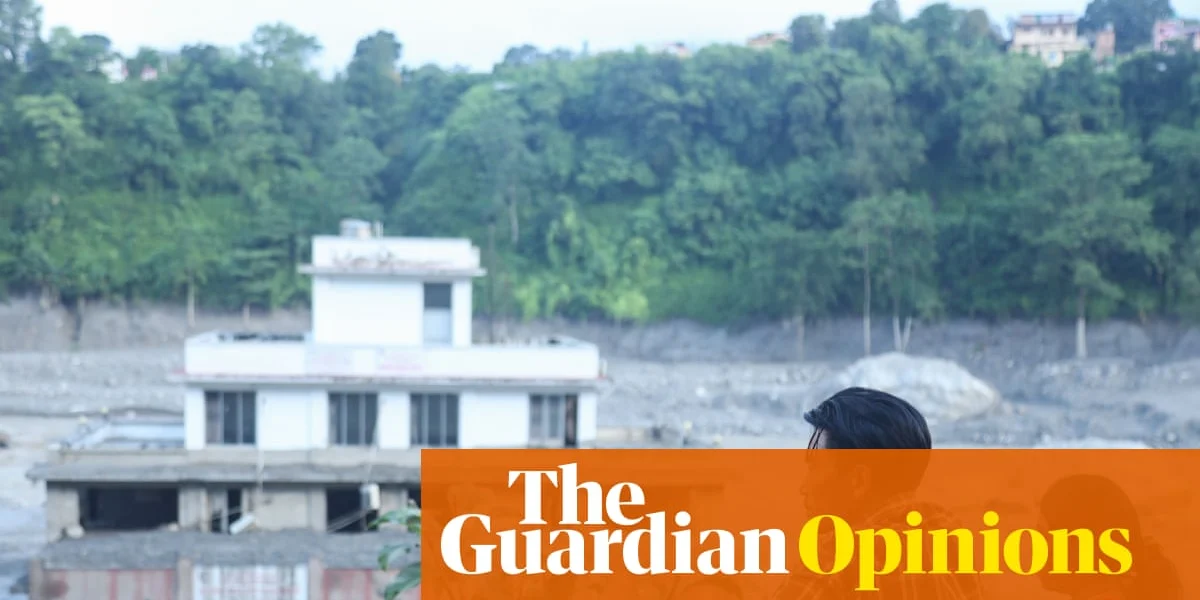
As a Nepali citizen working on international climate policy for more than a decade, it is difficult to look at the harrowing images coming out of the catastrophic flash flood that thundered down valleys in Nepal, sweeping down the Lhende Khola, Bhotekoshi and Trishuli rivers, and not feel angry.
Not just because of the destruction, but because it comes after years of warnings from scientists and civil society that a rapidly warming planet would make disasters more frequent, more intense and harder to predict. This is what the cost of delaying global climate action looks like.
On 26 August, a wall of ice, water, rock and mud tore through communities, destroying homes, markets, bridges, roads and hydropower infrastructure in Nepal and Tibet. Hundreds of people were killed and many more remain missing. The devastation came with terrifying speed. For people living along the rivers and the tourists trekking in the hills, there was little time between the hazard emerging high in the mountains and destruction reaching the valleys below.
The immediate questions are rightly being asked about what happened and whether people could have been warned. Nepal needs stronger early warning systems, better monitoring of glaciers and unstable slopes, cross-border communication between Nepal and Tibet and greater investment in preparedness.
Read more:Burnham is choosing jobs over climate security. That’s a big risk | Gaby Hinsliff | The Guardian
But Nepal’s flash floods expose something more fundamental: the problem is not the absence of a warning system – it is a climate crisis that is producing hazards that behave differently from those the systems were designed to detect.
The warning system in the high-mountain Bhotekoshi valley illustrates the problem. The sudden, debris-laden flood destroyed upstream hydrological stations before they could register a rising water level and trigger an alert. The system was designed to detect a more gradual rise in water levels. This flood arrived as a massive surge of rock, mud and water, destroying the very instruments meant to detect it.
Preliminary assessments indicate that a large glacial collapse triggered an ice-rock avalanche and debris flow, temporarily blocking the river before a massive surge travelled downstream. The precise sequence is still being investigated. Whatever the final scientific explanation, the event shows how quickly hazards can cascade in a warming mountain environment.
Read more:Gianni Infantino vows to ‘grow football’ as Nordic FAs reveal ‘lost confidence’
By the time authorities received information about the flood and warnings were sent downstream, communities closest to the source had virtually no time to respond. The monitoring infrastructure did not simply fail to communicate the warning. It was destroyed before it could see the flood coming. That distinction matters. An early warning system designed around yesterday’s floods can be dangerously inadequate for tomorrow’s extremes.
This does not make early warning futile. It means we need to be honest about its limits. A warning is useful only if there is time to act. It cannot stop a mountain of ice and rock from collapsing. It cannot protect infrastructure in an increasingly hazardous corridor. And it cannot bring back a home, a hydropower station or a livelihood once it has disappeared.
Adaptation has limits, too. For years, Nepal and other vulnerable countries have been ramping up efforts to adapt: by strengthening infrastructure, improving preparedness, and protecting livelihoods – but often without financial support from the countries that historically contributed most to the climate crisis through historical emissions.
Nepal needs much greater international support for adaptation: early warning, mountain monitoring, climate science, anticipatory action, resilient infrastructure and disaster preparedness. Because Himalayan hazards originate beyond national borders, this must also include stronger cross-border cooperation and timely sharing of information.
The Nepal Himalaya is changing rapidly. Glaciers are retreating, while warming is altering the conditions in which glaciers, permafrost and mountain slopes remain stable. The climate in which these hazards occur is changing, and continued warming will make an already difficult risk landscape harder to manage. That is why the global response cannot stop at adaptation.
The first task must be to stop making the crisis worse. The countries that benefited most from decades of fossil fuel-driven growth have a particular responsibility to cut emissions rapidly. They also have far greater resources to do so. A just transition away from coal, oil and gas towards renewable energy is therefore a matter of global justice.
The fossil-fuel industry cannot be separated from this conversation. Companies have made enormous profits extracting and selling the fuels that have driven global heating, while communities on the climate frontline are being asked to prepare for increasingly destructive impacts with far fewer resources. Even rapid mitigation cannot undo the warming already baked into the climate system or immediately reverse changes already taking place in the Himalaya.
Read more:Rafael Leão free to leave AC Milan amid Galatasaray, Aston Villa links – Ruben Amorim
There is also a lesson for Nepal. It should not copy the economic model that created the climate crisis and call it development. We have an opportunity to build something different: an economy that puts people, livelihoods and ecological resilience before extraction.
The second task requires historical polluter states to pay for loss and damages. Nepal has contributed less than 0.1% of historical global greenhouse gas emissions. Its per-capita emissions remain among the lowest in the world. Yet we are increasingly paying for a crisis we did almost nothing to create. There is something profoundly unfair about this.
The cost of such an event is not an abstract figure in a post-disaster risk assessment. It is the lives of people killed by the flood; a hydropower station that took years to build and disappeared in minutes; livelihoods; public money that must now be spent on recovery instead of health and education.
Nepal and other vulnerable countries have repeatedly called on developed countries for compensation. The country should not be forced to borrow to recover from disasters to which it contributed so little. Nor should its scarce domestic resources repeatedly be diverted to repair damage caused by emissions of the global north.
Loss and damage finance must therefore be additional to existing official development assistance, adaptation and mitigation finance. It needs to be accessible and predominantly grant-based. But it cannot substitute for mitigation. No amount of compensation will be enough if the world continues to burn fossil fuels at the scale it does today. No adaptation programme can keep pace indefinitely with a climate that becomes more dangerous every year.
The people living along the Bhotekoshi river did not choose a warming Himalaya. They did not choose the fossil-fuel economy that drove most of the warming. However, with enough support, they can prepare better and build more resilient livelihoods. Sadly, they cannot adapt their way out of every disaster. This is why loss and damage finance is not charity – it is an obligation to people already paying the price.