
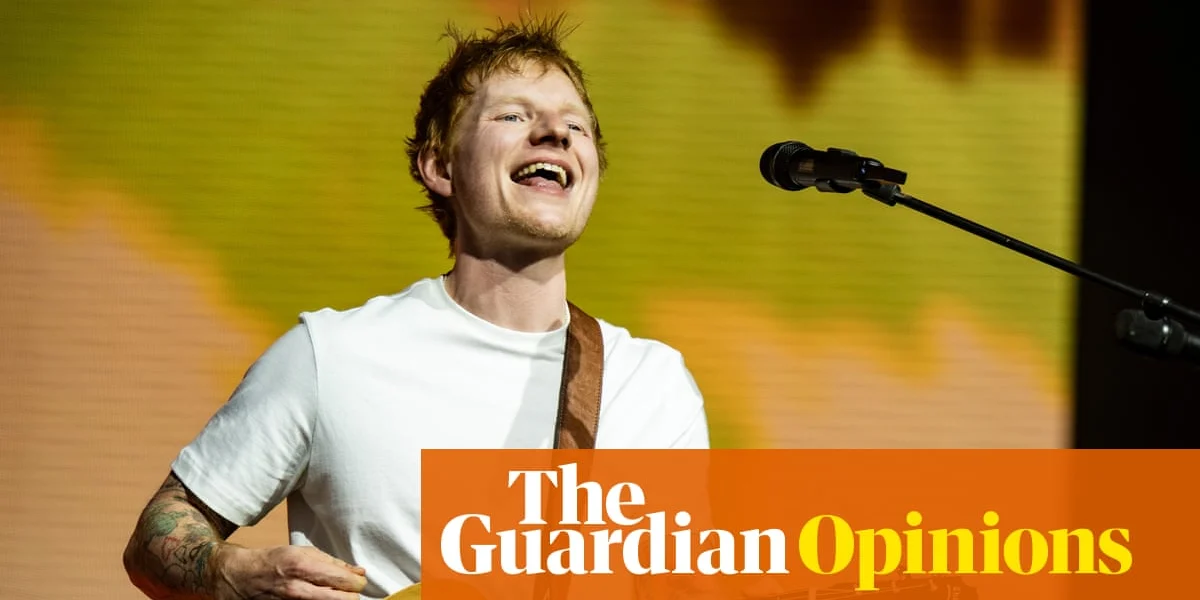
It must have come as a surprise to Ed Sheeran when all of his support acts withdrew from the remainder of the US leg of his tour. The American rapper Macklemore had triggered the walkout when he gave an impassioned speech calling for a “free Palestine” on stage and was dropped for doing so. The decision by the remaining acts to drop out in solidarity exposed a deep divide in the modern music industry.Some artists still insist on keeping politics out of music, while others expect music to speak to our perilous times.
After he was dropped, Macklemore wrote that Sheeran’s “typical apolitical stance was being challenged in a way it never had been before”, to which Sheeran responded: “I am not complicit” and “those who come to my shows do not expect a political forum”.
I think that the concept of expectation is worth probing. The idea that artists should make their political sentiments known is often dismissed as a parasocial delusion, one particularly rampant among young people on social media who “call out” musicians for their silence (indeed, young people are far more likely to be in favour of musicians using their concerts to make political statements). Artists aren’t politicians, the criticism goes, and to consider them as such distracts from, even compromises, the purpose of art as a forum for personal expression and of escapism. In other words, why not just enjoy the music instead of expecting activism from musicians, too?
Read more:The Premier League belongs to Erling Haaland after summer transfer window
The problem with that idea is that it treats a separation of art and politics as natural rather than something determined by historical convention. It wasn’t so long ago that expectations were quite different. There used to be a neater division between countercultural musicians who were relegated to the periphery and mainstream artists who would be disciplined if they spoke up.
The MTV era of music in the 2000s prioritised blockbuster, spectacle and glamour, while avoiding political, social and economic controversies. Artists were generally expected to keep politics out of their music. When Madonna challenged that idea in 2003 with her single American Life, which opposed US foreign policy and jingoism at the onset of the Iraq war, the backlash was heavy: she was forced to dump its “un-American” music video, and faced heavy radio blacklisting. It took years for the Chicks, then known as The Dixie Chicks, to recover commercially from the backlash they faced to their criticism of the Iraq War and George W Bush around the same period.
Read more:Psychedelic ‘Furthur’ bus rolls back into San Francisco for new Grateful Dead exhibit
Today, the expectations that audiences have of artists are different from two decades ago. Partly, this is because the economics and the technology behind the music industry has changed. In the age of streaming, it is harder to silence artists who have made politically problematic statements – radio station blacklisting is far less fatal than it was before people discovered music through their phones and algorithms.
Interestingly, this greater political autonomy also means that the biggest artists take less of a commercial hit in their worst moments. After Kanye West’s antisemitic rants (which the rapper apologised for), his album Vultures still reached No 1 on the Billboard charts in 2024. On his most recent tour, he performed at AT&T stadium in Arlington, Texas, one of the venues that banned Macklemore from performing.
In any case, this greater autonomy pushes young fans to ask: why not take the risk? Why not speak? Particularly in the case of Palestine, it has often been smaller and less influential artists who have done so. Think of how the scale of Sheeran’s commercial reach, by contrast, dwarfs that of the artists around him who have risked more by speaking out.
Artists, both alternative and mainstream, have also set this expectation for each other. The stances a musician has taken on pressing issues are no longer just cudgels used against them. Rather, silence on these matters has become a source of shame.
Billie Eilish rebuked her fellow celebrities for not taking a stance against Immigration and Customs Enforcement (ICE) in the US and its killing of civilians. The Irish singer-songwriter CMAT, who I saw at Glastonbury last year leading a “free Palestine” chant on the Pyramid Stage, had this to say while receiving the award for best album at the Ivor Novello Awards this year: “I have a very specific idea of what songwriting is supposed to be for, and I think it is to reflect the times through your own personal view so that everybody can have something to connect to and something to learn from years later. And now I would compel my fellow artists in the room, it is not the time to sit on the fence.”
Read more:Disputed ADA investigation prompts boycott by diabetes leaders
The political shift in music also reflects a tonal shift. Artists have become more emotionally intimate with their audiences. I was struck by an analysis published earlier this year by the music data company Musixmatch for the Economist, which assessed lyrics from the Billboard charts to conclude that pop music has become “gloomier”. The most popular songs increasingly invoke sadness, angst and heartbreak.
A study in the Times also found that the musical mood has become more downbeat. This is in itself not surprising – listeners increasingly want authenticity from musicians and depend on it for a sense of connection. Think of the music of Eilish and CMAT, both of whom are popular with young audiences and praised for filterless emotion. They invoke that gloom, vulnerability and emotion – in other words, they communicate pain as a central tenor of their sound.
As CMAT said of her music, which muses on isolation, capitalism and disillusionment: “Everyone has the same wants and desires, and if you’re really honest as an artist with your pain, it will always connect.” For many young people, part of the pain they have felt in the past few years has been in witnessing the events in Gaza, as well as the rising global tide of far-right populism, the climate crisis and instability. So for a generation that is increasingly accustomed to having their despair made audible through gloomier music, why would they not increasingly expect artists to draw connections between their personal pain and what is causing it?
Artists, then, cannot assume that the old bargain still holds. Sheeran’s insistence on an apolitical arena of music is increasingly anachronistic – a position that has exposed the faultlines of modern music. Many listeners increasingly seek emotional clarity as well as moral clarity. Whether popular music has risen to that moment will be judged by history. But for now, as the expectation changes, it is down to artists to decide if they change with it.