

Men age and die, but in the Balkans, time stands still and is stuck. General Ratko Mladić, who died in prison in The Hague on Thursday aged 84, remains a hero in the Republika Srpskastatelet – the Serbian half of dismembered Bosnia that he carved out with a hurricane of violence between 1992 and 1995 – and in Serbia itself.
Too many Serbs in whose name Mladić carried out his mass murder of other ethnicities – mainly Muslim Bošniak and Roman Catholic Croats – adore him and mourn his passing.
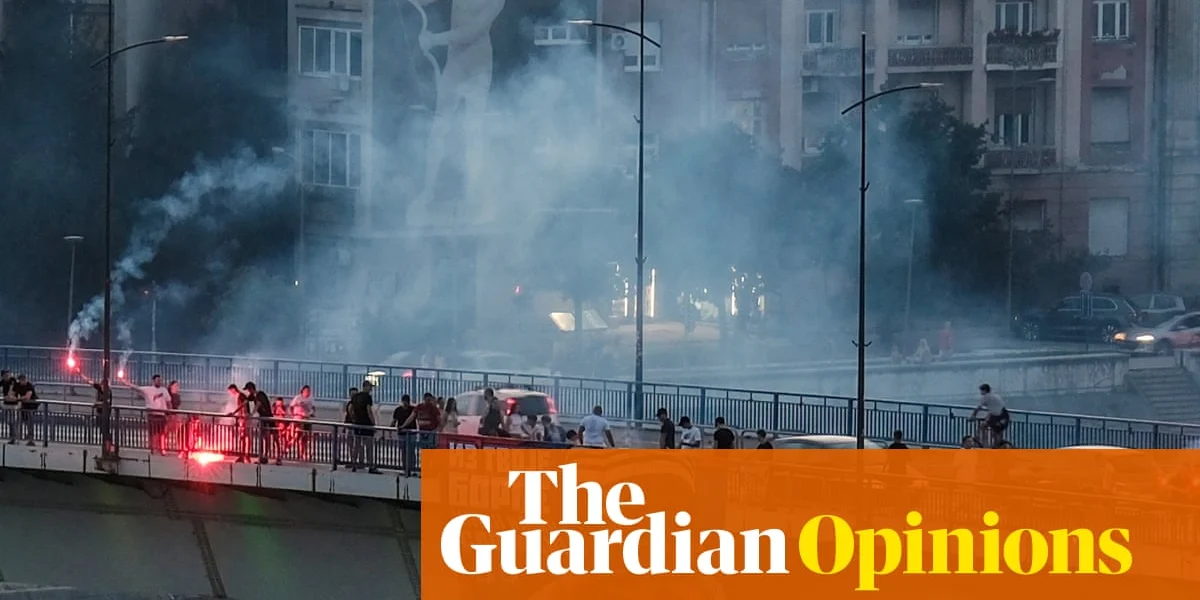
Since Bosnia’s war ended, Mladić’s portrait has adorned posters, gable ends, mantelpieces and football fans’ flags. Supporters of Red Star Belgrade marked his death at a match against Viktoria Plzeň on Thursday night with banners reading: “General: Eternal glory. Thank you.”
Read more:Closing statements to begin in trial of man accused of orchestrating Tupac Shakur killing
Republika Srpska’s former president Milorad Dodik extended his condolences to the Mladić family and paid tribute: “Republika Srpska will not forget his role, just as it has not forgotten it to this day. A man has died who was the commander in the struggle for the freedom of the Serbian people here, a commander who led the honourable army of Republika Srpska from the first day of its establishment. A man who demonstrated his human and military character.”
Conversely, in the 30 years since the war ended, there has been scant apology from Serbian quarters to those people, most of them Muslims, who survived Mladić’s massacres, and no reckoning. Au contraire: across Republika Srpska, hatred of what remains of “the other” and for federal authority in the capital of Sarajevo is palpable and quotidian. A friend writes to me from Bosnia: “We’re still living with the legacy every day. Listening to Republika Srpska, to Dodik, to [Serbia’s president] Vučić, the same old lies, the same old denial.” There is mass collective amnesia, denial of or – nonsensically – justification for what was done.
Mourners who gather annually at the mass cemetery of victims of the Srebrenica massacre of some 8,000 men and boys in July 1995, and for commemorations at concentration camps, are routinely harassed by police and onlookers. It is made clear to Muslims and Croats who have dared to return to Republika Srpska in the north-west and east of the bitterly divided country that, if they could, the Serbs would do it all again.
Read more:The Home Office must not be allowed to bury the spycops inquiry | Imran Khan | The Guardian
Mladić had a singular, and singularly nasty, squint. You can see it in the footage of him as he prepared the Srebrenica massacre, and in photo portraits that abound this weekend. For very many, it was a death sentence; for me, it was a stab across a courtroom at the international war crimes tribunal in The Hague as I took the witness stand in 2012 to testify against him. Having delivered that terrifying gaze, Mladić never met my eyes again during a half day of evidence from the ground of atrocities committed by those under his command. He sent a shiver of fear down the spine of anyone near him, and he knew it.
Mladić was the military wing of an unholy trinity: at its apex, Serbia’s then president, Slobodan Milošević, resurrected the insane idea of a “Greater Serbia”, a form of nationalist fascism whereby wherever the Serbs lived, only Serbs would live – everyone else would leave or die, and every vestige of their culture and religion (Muslim or Catholic) would be erased. His political co-commander in Bosnia was Radovan Karadžić, president of the self-declared Bosnian Serb republic. Milošević died while on trial at The Hague; like Mladić, Karadžić was convicted of genocide and other war crimes and remains jailed – surreally, on the Isle of Wight.
If Milošević and Karadžić were dangerously deranged, Mladič was bloodthirstily effective. He was the killer, the “Butcher of Bosnia”. To invoke and invert Hannah Arendt, if the others were the evil of banality, Mladić was the real thing: the banality of evil.
Mladić was a military more than an ideological man, a career officer in the Yugoslav army. He knew what he was doing. Transcripts of the Bosnian Serb assembly submitted to The Hague by an historian at the University of Michigan, Robert Donia, show Mladić expressing concern in 1992 that the political leadership was setting goals that would be hard to achieve. “We cannot cleanse, or sift with a sieve, so that only Serbs would stay, or that the Serbs would fall through and the rest leave. I do not know how … Mr Karadžić would explain this to the world. People, that would be genocide.” And so it was – at Srebrenica at least, according to The Hague tribunal – and as a good military commander, Mladić obeyed his political masters and enforced his own orders.
Mladić was convicted at The Hague in 2017. The media talked about “closure” for his victims. Wishful nonsense: there is no “closure”, nor can there be as long as the Serbs celebrate this creature.
Read more:Meep, meep. ‘Coyote vs. Acme’ opens with $15.5 million, ‘Spider-Man’ stays No. 1 for fifth weekend
Most discussion of Mladić since his passing has inevitably invoked Srebrenica, the infamous massacre. There is the TV footage of him smirking, knowing what was to come. But it was not only Srebrenica. Srebrenica was the most egregious war crime, but it was a denouement: more than 55,000 Muslims and 7,000 Croats had already been killed in other places over those three years, and two million had fled their homes. Foca and Višegrad (sites of rape camps for the indulgence of Mladić’s soldiers); Rogatica, Vlasenica and Sokolac; Bjeljina and Brcko, Kozarac, Sanski Most, Ključ … the list goes on. The siege of Sarajevo counted 11,541 deaths, including 1,600 children.
Mladić achieved most of what he set out to do. The “international community” granted the Bosnian Serbs a large part of what they killed, raped, tortured and burned for with the Dayton peace agreement, signed in 1995. There was baffling agreement from the Muslim-led government, apparently more anxious to establish its own sectarian fiefdom than unite the republic in a war that the Bosnian army was – actually, finally – winning by that summer (in a counteroffensive that put Mladiċ’s soldiers to flight, liberating territory then returned at Dayton to Republika Srpska).
Mladić succeeded in persecuting a very Bosnian, casually convivial interpretation of Islam into something more identitarian and polemical. In the absurd waltz of aspirant accession to the EU, Serbia leads the Balkan queue, ahead of truncated Bosnia, despite Belgrade’s open allegiance and subservience to Russia.
Read more:‘RIP King’: Fans pay respect to Tupac Shakur, hope for justice as murder trial nears the end
Above all, Mladić has succeeded in death, as he did in life, because of the adoration he still commands. His mission to establish an ethnically “pure”, fascistic Greater Serbia remains a dream, anda plan. Through public celebrations, he continues to terrorisethe lives of those mostly Muslims and a few Croats brave enough to return to live under the insignia of those who mass murdered their families.
Mladić’s funeral will probably tell us more than his death. Several Serbian government officials and ministers urge a “state and military funeral, and day of mourning”. The president, AleksandarVučić, says he will leave arrangements to the general’s son, Darko, who is of the faith. If Darko decides on full national honours, that is what will happen. Mladić is dead, but lives on.