
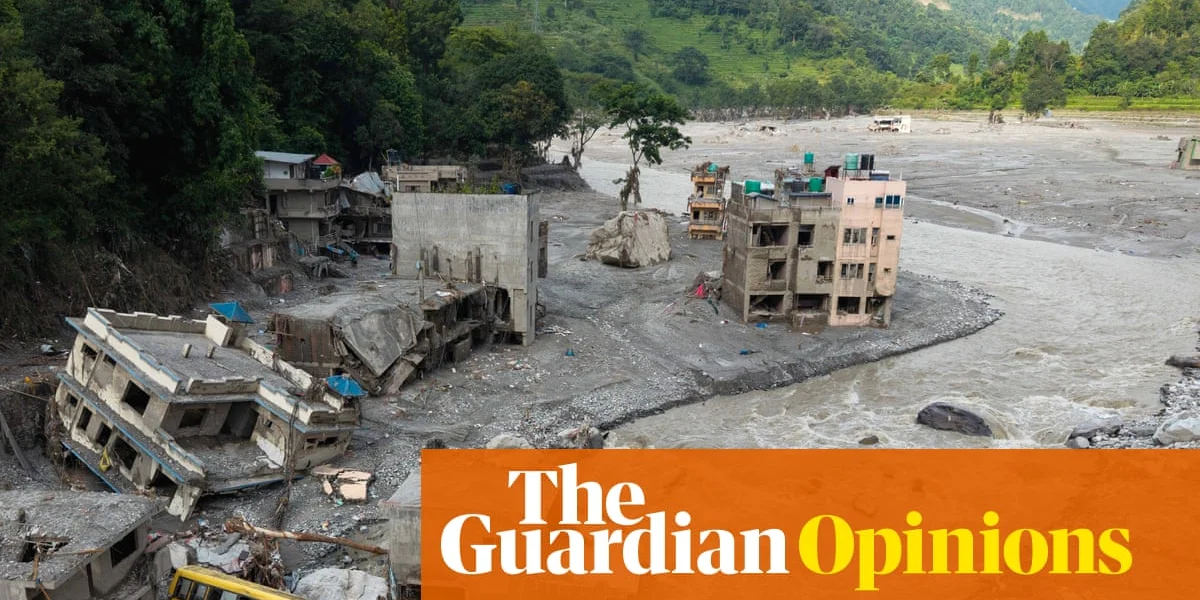
Climate breakdown is happening on one Earth, but two different worlds. In one, its impacts increasingly encroach on everyday life; longer periods of discomfort and shorter periods of sharp pain. Endless, hotter summers, and within them sudden wildfires, evacuations, homes burned to cinders in a matter of hours. In another, catastrophe. This summer has been a snapshot of that split-screen. The hottest day on record in parts of Europe, and a wave of water, mud and ice in Nepal that so far has claimed more than 750 lives. Thousands of people are still missing.
The difference is also one of resources. The climate crisis has an economic cost, but some places can absorb it better than others. Responses to this summer of wildfires in Europe included a rapid scrambling by the French government to provide everything from tax breaks for businesses affected by the fires to relocation costs and aid to rebuild homes. The UK government had deployed almost £100m before the summer to strengthen wildfire resilience.
Entire industries exist to absorb the impact, undergirded by sophisticated technology, disposable income and evolved sectors. Wildfire insurance in the US is being powered by AI, which spits out numbers to estimate risk based on location and construction material. Outside North America and Europe, there is little of that buffer. The result is asymmetry. While developed countries will still be stressed as events triggered by climate breakdown become more regular and chronic, and they are still not immune to globalised outcomes – rising food costs, droughts, water shortages – what they experience and how disruptive that will be are far removed from other parts of the world.
The difference in scale and resources is colossal. What is needed to rebuild Nepal’s flood damage may constitute up to a 10th of its entire economy – something like $5bn, and that’s not even factoring in all the technical foreign assistance, equipment, expertise and labour required. Also colossal is the difference in exposure to the obliterative effects of events.
Read more:Who are Sabah FK, Champions League debutants, Arsenal/Man United opponents?
Take the death of coral reefs, and how that disproportionately affects coastal populations. Across the Caribbean, coral bleaching caused by rising ocean acidification and temperatures not only dramatically reduces marine life, which is a source of food and income for entire populations – 90% of Jamaica’s economic income is generated alongside its coasts – but also increases the scale and intensity of storms. Coral reefs are a sort of natural storm barrier, absorbing the force of sea waves and buffering coastal areas from flooding. The intersection between these geographical and economic features means countries in the Caribbean are being pummelled on the weather front (climate breakdown also increases the power of hurricanes through warming ocean water), as well as having their incomes drastically reduced and therefore their ability to bounce back.
Then there is the heat. Temperatures are not just jumping far above the average in Europe but also in warmer areas where the base temperatures are already high. Last week, a Harper’s Index summary of estimated heat-related mortality in India showed some staggering numbers: 3,400 excess deaths “caused by a single day of extreme heat”; 30,000 deaths “caused by five consecutive days of extreme heat”. In April of this year, all 50 of the world’s hottest cities were in a single country, India, something which according to the air-quality monitoring platform AQI “has no modern precedent across global weather data”.
This is another double whammy for poor communities without access to shelter or cooling systems of unlimited fresh water. These are the so-called climate breakdown hotspots, identified as “areas where strong physical and ecological effects of climate change come together with large numbers of vulnerable and poor people and communities”. Few places on Earth demonstrate this category more vividly than Sudan. A country already in the grip of war and food insecurity is now succumbing to the delayed rains caused by the El Niño climate pattern, cracking the dry earth and draining the Nile. The risk of famine stalks populations that are already acutely hungry.
And what is felt asymmetrically has been caused in that way too. These poorer, more vulnerable countries are paying the price for the emissions caused by wealthy countries, and not even being extended the full, remedial support from the coffers of those nations that accumulated the wealth generated by industries that contributed to climate breakdown and global heating. We are not just battling complacency, or indifference to the importance of climate justice, but a political climate that has in recent years, led by Donald Trump’s second term, seen its own collapse.
Look closer and the problem isn’t only historical failure but a casual disregard, an adventurism that launches wars and stresses economies with buffers already damaged by the climate crisis. The Iran war in combination with El Niño is a weather and politics collaboration that has hiked fertiliser costs on the one hand and choked rain on the other. More broadly, what was a generously named albeit tenuously implemented “rules-based order”, which at least had some bedrock of global cooperation and aid, has been cancelled altogether. Trump’s withdrawal from the Paris agreement set the tone, while the dismantling of USAID cut the funds that diverted billions of dollars from the rich to the developing world to help with the fallout of extreme weather and reduce greenhouse gas emissions.
Here is another cascade. As the US withdraws from its commitments, sending the signal that there are no rules or duties, and indeed no problem with climate breakdown at all, pressure will rise on other countries to contribute more. They will need to figure out a way to hold together a coordinated response in the shadow of a destabilising hegemon, as well as try to foster that sense of social obligation in a time of political sociopathy.
The foolish shortsightedness of it all is that even though there is a large gap between experiences, and so a sense that glaciers and floods and famines are happening all the way over there, their knock-on effects and food supply challenges, and political and refugee crises, will affect us all. Things will get dramatically worse for the hotspots, but there is still no outrunning it all in the long term. It seems that at precisely the moment when this realisation should yoke us together in all the ways life is rapidly changing, we are all being untethered. But ultimately, whatever different spheres we inhabit, we are all still trapped on the same planet.