

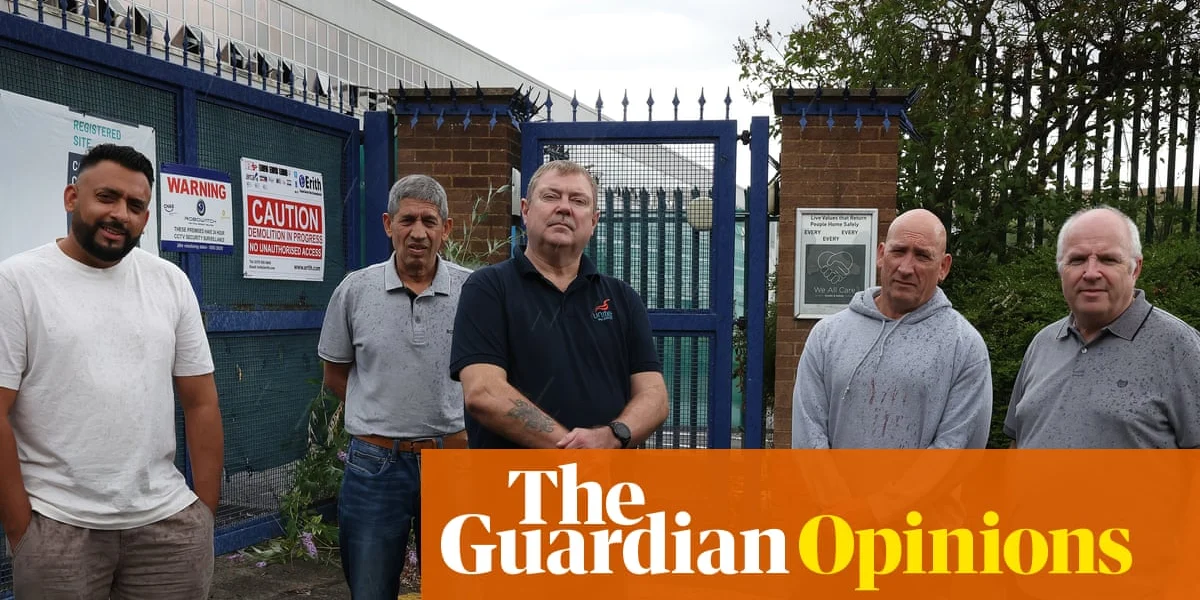
After everything, why would anyone still back Nigel Farage? In some of the comments below my piece last week about Reform UK, I spot the usual answers: Farage’s supporters are dim, racist, deplorable. Yet away from Westminster and the news cycle, Reform voters are being manufactured – not with headlines or crypto funds but through the failure of institutions they once trusted to protect them. To see what I mean, leave SW1 and go 40 miles up the road, to Luton.
In a deserted hotel bar, five men are reminiscing about how their world ended. Their minds are on a Friday afternoon in March last year, as the place where they had worked for two or three decades apiece, making friends and even meeting future wives, is about to shut for good.
Vauxhall came to Luton not long after the death of Queen Victoria; it helped build the town and gave it an economy and an identity. At its peak in 1971, the company directly employed 37,000 staff in Britain, mostly in Luton. Now it is leaving. On this afternoon, these men and so many of their soon-to-be ex-workmates are crowded around the assembly line. As the last white van comes off, they clap and cheer with pride for what they had been part of. Some cry. “It’s as if you had lost someone in your family,” remembers Paul Geary, whose ties with this place are four generations deep.
“It’s such a chunk of your life,” says Gerald Shalvey, who gave the company 34 years of his. Later, he walks back out on to the line and surveys the site where until this afternoon 1,600 people had worked. For the first time ever, the machinery is still and he hears nothing but silence: “an industrial graveyard”. Then he wonders what comes next, for him, his mates and his town.
Read more:Everything you need to know about the 2026 Venice Film Festival
For the hard right and far right alike, Luton is a contemporary hell. The star of countless memes and YouTube films, it spells migrants, Muslims and growing poverty. For some key players, the connection is personal. Luton boy Stephen Yaxley-Lennon, also known as Tommy Robinson, has talked of how his stepfather worked at Vauxhall. Andrew Tate grew up in what he calls “the worst area of the worst town” (actually, the same estate as Geary). They lived through Luton’s long decline; then they monetised it.
The ex-Vauxhall workers talking to me are nothing to do with the rightward exploitation. But since their factory’s closure, they have seen fellow union members switch in droves from voting for Keir Starmer in 2024 to backing Farage. It’s not just Labour; their disgust is at a society they feel has let them and their families go under. A similar process is at work in other “industrial graveyards” from Grangemouth to Port Talbot and across the west.
In the east German province of Saxony-Anhalt, the far right looks set this weekend to win governing power for the first time in decades. Its current state premier, Sven Schulze, knows why: “We’ve seen how quickly we can lose our jobs, how quickly a company can disappear. That’s the experience east Germans have had, and it’s far deeper than west Germans think.”
Read more:Fall Movie Preview: Russo brothers, maestros of ensembles, test their limits in ‘Avengers: Doomsday’
There isn’t the space here to look closely at how Vauxhall left Luton, but the final episode comes in three parts. First, the then boss of the company’s owner, Stellantis, visits the plant early in 2023 and tells staff they need to halve manufacturing coststo compete with employees in Turkey. Whether Luton lives or dies is in their hands, he says, ending: “Good luck”. (These events were recalled by several employees and were not disputed by Stellantis.) Workers and managers collaborate and through a lot of sacrifice almost halve costs. It makes no odds: late in 2024, Stellantis announces it will close a plant that is profitable. Only Ellesmere Port will be kept open.
“Corporate greed,” say the trade unionists, who make counter-proposal after counter-proposal, to no avail. Some Unite members grumble to me about their leaders not fighting hard enough, and cite among examples a key meeting with the business secretary, Jonathan Reynolds, which the Unite head, Sharon Graham, did not attend but sent an aide. (When I checked this with Unite’s press office, it replied with lawyers’ letters and a statement saying Graham had “a pre-arranged meeting” but that she had negotiated directly with both Starmer and Reynolds on a government package of support to keep Luton open.)
Labour ministers make clear they will “support” Stellantis financially and otherwise to stay at Luton. But in dealing with this multinational carmaker, a G7 government does not have much more sway than a shop-floor steward. At the start of 2025, a frustrated Reynolds writes to a Luton MP that “despite these repeated offers from my department, Stellantis have been unwilling to engage in any discussions”. Then comes that Friday afternoon in March. As their factory closes for ever, workers are given a commemorative brochure and a medal made of scrap metal.
Now see this from a Luton worker’s point of view. The company to whom you’ve given half your life has first castigated you for not being as cheap as your Turkish counterparts, then upped and left. The union to whom you pay your subs wasn’t able to stop it going. Also impotent was the Labour government you voted for – again. Luton lost its car plant under Tony Blair, it lost its van plant under Starmer. Now you’re out of work, and – in the case of Mohammed Hussain, sitting next to me – you’ve just bought a house with a hefty mortgage. More than a year later, he’s still out of work.
Throughout our conversation, one man has barely spoken. Malik Mahmoodcleaned at Vauxhall for 26 years; only now do his words come, in fits and starts.
“One year I struggled for work.” He went for so many jobs – “50? 60? Fucking loads” – but this honest man with a quarter-century of loyal service found no takers. The big black mark, he thought, was age: Mahmood is deep into his 60s. After months of burning through his Vauxhall payout, he took jobseeker’s allowance, walking through the town to sign on, getting £84 a week and an inquisition from jobcentre staff. He mimics them – “What you did? Have you found a job?” His face is etched with years of hard work and worry.
Read more:Federico Chiesa left out of Liverpool’s Champions League squad
A few months ago, Unite published an internal report on the lessons from the closure of Vauxhall Luton. It’s a rare document, not least because trade unions like to celebrate victories rather than dwell on defeats, and this is its first mention anywhere in the press. At its heart is a survey of ex-Vauxhall workers and the finding that, a year after closure, like Mahmood and Hussain, 30% were still unemployed. At the same time, the report found, those ex-workers switched their politics. Less than 10% backed Labour as of this spring; more than 50% supported Farage.
In June, Mahmood finally landed a position in one of the new warehouses out of town. Now he depends on a mate to give him a lift into work, and his pay today is £1,000 a month lower than it was 18 months ago. This is typical of other Vauxhall survivors, the Unite report shows: even the winners have lost out. Getting laid off in a cost of living crisis is expensive, and the men here today rely on family members for help, and cut back on heating and groceries.
In the late 1960s, a group of sociologists visited then booming Luton, interviewing workers at Vauxhall and elsewhere for a renowned series of books, titled The Affluent Worker. Its central question was: when the working classes get middle-class salaries and mod cons, what happens to their class identity? Sixty years later, Britain is running the experiment in reverse, driving working-class families into deprivation and smashing up their communities. The results are not yet in, but they look bad.
The closure of Vauxhall Luton leaves a “vacuum”, says Geary: economically, socially and politically. “These were solid jobs with pensions and you were getting good money. You could get qualifications, a mortgage. What are the kids going to train at school to be? All on social media?” That vacuum, he says, is where the hard right and far right step in.
None of them set much store by Andy Burnham’s pledge to reindustrialise Britain. The workers have gone, and so have their skills. The economic models these guys discuss now are Donald Trump’s protectionism and Beijing’s historic public investment. European social democracy doesn’t rate a mention. “The system of capitalism is dying because people are seeing it’s not worked,” says Gary Reay.
We end by doing the photos, walking along the road that was once all Vauxhall. To get from one end of the site to the other was once a 15-minute walk filled with noise and people. Now the only sound is planes screaming away to holiday destinations. Shalvey points out the large Vauxhall badge still hanging from a brick wall. “What a waste,” he says. “What an idiotic waste of potential.”