

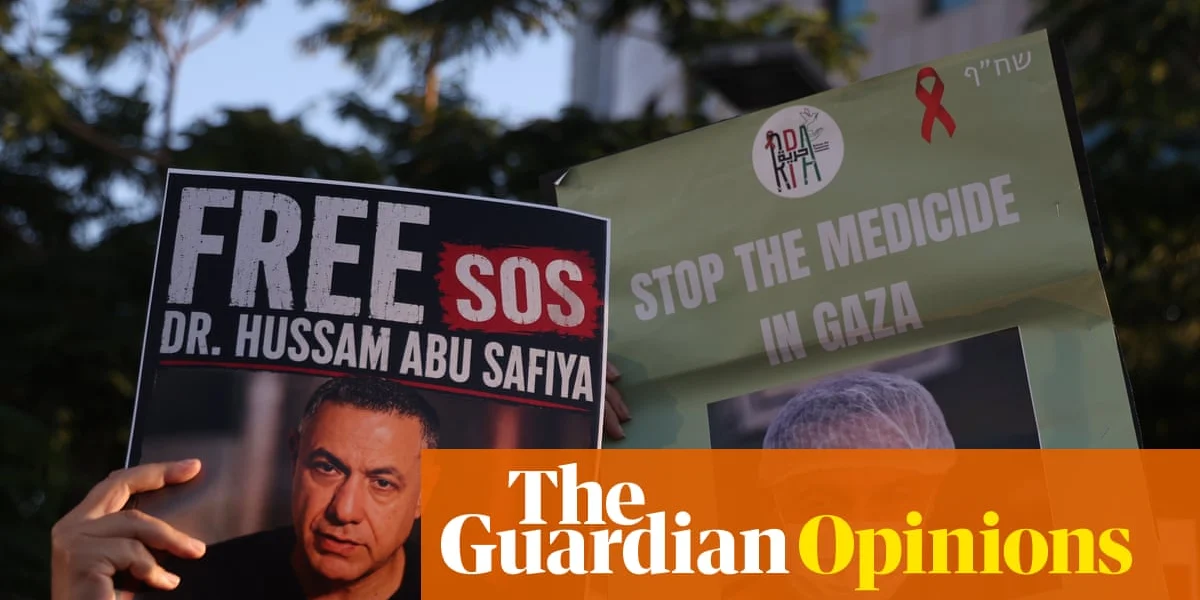
“This is the end. I don’t see myself surviving. They brought me here to kill me.” These were the words of Dr Hussam Abu Safiya to his lawyer earlier this month. Abu Safiya was the director of the Kamal Adwan hospital in northern Gaza. Eighteen months ago he was seized by Israeli forces and has since been held without charge or trial. He reports being struck with hammers and batons, daily beatings and loss of consciousness. The latest images of him show a much gaunter man than the one who had been the voice of besieged healthcare workers in Gaza, doing their jobs in impossible circumstances.
In June, Abu Safiya was transferred to Rakefet prison, an underground facility first built to hold senior organised crime figures, then closed on the grounds that it was inhumane. It was reopened in late 2023 by the far-right national security minister Itamar Ben-Gvir. Abu Safiya and the other Palestinian prisoners there never see daylight, a violation of the Geneva conventions. Across the Palestinian territories and Israel, about 3,500 prisoners like him are held under “administrative detention” that can be renewed every six months, indefinitely. Nearly 200 of them are children. Once a Palestinian is detained under these rules, they are essentially abducted by the state.
“Real hell” is what is experienced once detained. Ali al-Samoudi, a Palestinian journalist, was released earlier this year, unrecognisable. He had lost 60kg, about half of his body weight. “Prison today is hell in every sense of the word,” he told CNN. “Everything they practised with us was punishment and revenge.”
Read more:Progressive primary victories have corporate Democrats panicking | Norman Solomon | The Guardian
The scale of abuse, torture and death in Israeli prisons is well documented, but every once in a while an image appears that is Abu Ghraib-like in its relish and abandon. Earlier this month, a photo taken by an Israeli soldier was posted on social media. It shows a Palestinian man from Gaza face down, stripped to his underwear, bound with ropes to a plank and an iron rod. The caption said “good morning” in Hebrew. The echoes of Abu Ghraib were all there, the sinister gloating, the sexualised humiliation of stripped prisoners, the taking of photos as some sort of trophy.
These are not isolated incidents, or even measures established during the current conflict, although they have accelerated during it. The administrative detentions and abuse are part of a wider longstanding system that has severed Palestinians from human rights, and appears to be designed to terrorise, break morale and collectively punish. For decades, the Israeli state has practised a policy of keeping the bodies of Palestinians, refusing to hand them over to their families for burial. Some bodies are buried in numbered graves in sealed military zones, others are held in freezers. Among those are 100 Palestinians who died in Israeli custody. No information has been provided about how they died.
And then there are the missing. Those in Gaza who, according to eyewitnesses, were detained by Israeli authorities, but never recorded. These amount to “enforced disappearances” according to the Israel-based human rights organisation HaMoked, which is trying to trace the whereabouts of almost 2,000 people.
These are only snippets, snapshots of a state in which Palestinians live under a regime of torment. The result is layered, diverse and complex forms of trauma that seem to signal to Palestinians that their lives and even corpses belong to the Israeli state. The practical infrastructure of abuse is shocking enough, but it feels like there is also an important psychological dimension, a sort of continuous smothering of the notion of autonomy.
Read more:What to Stream: ‘Heartstopper Forever,’ ‘Lucky’ and Steve Lacy
So many of the detained include those with roles and profiles that suggest leadership or express community values; journalists, doctors and civil society members. These people are part of the network that underlies a state or society, which must be shattered to communicate that there is no such thing as Palestine or a Palestinian people.
What is remarkable is how much of it is happening in plain sight. How often it is shown clearly by a picture, whether it is of footage of a Palestinian prisoner appearing to be sexually abused, or of the man in his underwear tied to a rod. How much it is documented by rights groups, posted by Israeli soldiers, bragged about by Israeli politicians. And how little it is protested within Israel, or how rarely it moves Israel’s allies in the west to express real outrage or demand real action. In the UK there is a focus on settler violence, sanctioning settlers and as Andy Burnham recently suggested, banning trade with illegal settlements. But that seems like an effort to locate the main problem away from the heart of the Israeli state.
Read more:What to Stream: Rolling Stones, ‘Little House on the Prairie’ and ‘Backrooms’
As fading Palestinian prisoners in dungeons appear before the eyes of the world, their deaths foretold, I think back to Abu Ghraib, and how much those pictures moved and scandalised and came to define an entire era of unbridled power, racism and cruelty. For that to happen, there needed to be a media and political class that pushed for investigation and accountability.
Where is that to be found now, either within Israel or among those who can apply leverage from outside? There is some promise in the fact that the UK deputy permanent representative to the UN recently said that the UK is concerned about “the documented sexual violence perpetrated by Israeli forces against Palestinian detainees”, and called upon Israel to investigate. But I suspect everyone knows that will not happen.
Read more:Is Mitch McConnell secretly deceased? | Arwa Mahdawi | The Guardian
Because what is taking place is not an aberration, not a deviation, but a norm that is enacted and blessed explicitly by successive generations of Israeli politicians and, it seems, by Israeli society. Until that fact is confronted, Palestinians will continue to be detained, disappeared, tortured and sexually abused, and the abusers asked politely, concernedly, occasionally, to please investigate themselves.