

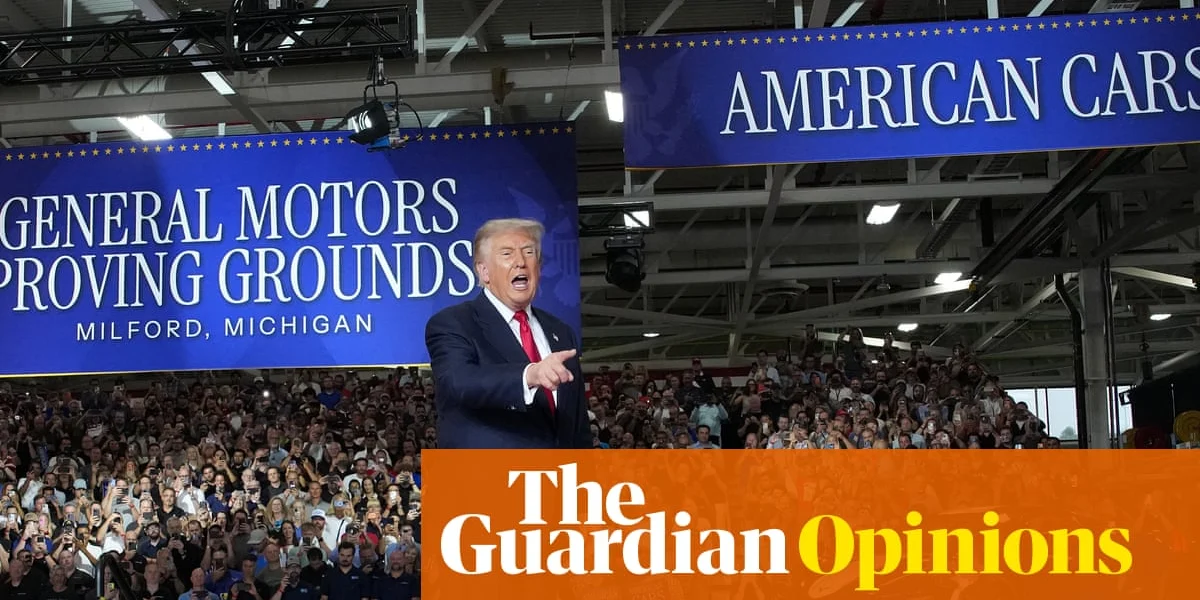
Donald Trump may have found the killer weapon to punish countries at will: by imposing tariffs on their exports to the United States.
The president has been looking for a new tool since February, when the supreme court struck down tariffs he slapped on virtually all of America’s trading partners based on the International Economic Emergency Powers Act, or IEEPA, on the spurious grounds that the US faced a variety of national emergencies. It’s become a parlor game among policy wonks to predict what new legal justification he would deploy to replace them.
Well, it’s probably not what you think. The round-robin tariffs imposed on everybody last Friday, under the argument that America’s trading partners unfairly undercut US companies by importing things made with forced labor, has drawn a lot of attention. The blatantly specious accusation, sitting uneasily alongside America’s own state-sanctioned abuse of forced labor, underscored how low Trump will stoop to get his way on trade.
But those tariffs, imposed under section 301 of the Trade Act of 1974, do not provide the carte blanche Trump wants. Tariffs under this section are meant to retaliate against specific “acts, policies and practices” that are “unreasonable” and “burden or restrict” US companies. A blanket charge that every foreign country is enabling forced labor and thus hurting American business is unlikely to fly in court. The whole strategy can be challenged as “arbitrary, capricious, an abuse of discretion, or otherwise not in accordance with law” or as “unsupported by substantial evidence”.
Read more:FIFA exec on White House World Cup panel resigns to protest Infantino plan
The truly menacing precedent comes from Trump’s decision, made the Monday before the worldwide forced labor tariffs came into play, to foist a 50% tariff on imports from Canada.
The White House’s pretext is Canadian discrimination against American dairy, booze and cars, which, paradoxically, came about as retaliation against Trump’s original barrage of tariffs last year. Sly observers, however, have pointed to Trump’s threat to punish Canada for the forest-fire smoke that wafted into the US. Maybe the new duties are meant to soften Canada as talks get under way to renew the USMCA North American trade pact, or to convince Canadians to become America’s 51st state. Or just because “tariff” is a pretty word.
The authority Trump invoked to attack Canada is ominous: section 338 of the Smoot-Hawley Tariff Act of 1930, which is the law that choked global trade in the 1930s and helped sink the world into the Great Depression. Section 338 is particularly dangerous because it offers cover for the president to slap trade levies on whatever country he wants under some fairly hazy arguments.
Read more:‘Spider-Man: Brand New Day’ nets second best North American opening ever with $355 million
Specifically, it grants the president authority to retaliate against countries that do anything to put the United States “at a disadvantage compared with the commerce of any foreign country”. As soon as the president decides this is going on, he is authorized to “declare such new or additional rate or rates of duty as he shall determine will offset such burden or disadvantage”.
Until Trump, section 338 was never invoked to impose tariffs. It was mostly used as leverage, to guarantee that other countries treated American products the same as imports from anywhere else. If some country offered preferential access to a neighbor or ally, the US could demand the same terms, or else.
This principle is now called “most favored nation treatment,” which is central to multinational trade rules enforced by the World Trade Organization. Trump doesn’t care about such niceties, though. He has a more destructive agenda in mind. And the statute appears to give him semantic wiggle room. He is determined to pursue his trade war. With such a sprawling mandate, he may be difficult to stop.
America’s trading partners were elated in February when a 6-3 majority on the court, including two justices appointed by Trump, ruled against his use of the 1977 IEEPA to impose tariffs at will. It was close, though.
The court has shown an almost unbelievable deference to the president. It didn’t object to Trump’s spurious invocation of national emergencies – a “public health crisis” due to illegal drugs from Canada, Mexico and China; trade deficits that “led to the hollowing out” of American manufacturing; something something because Brazil jailed its ex-president Jair Bolsonaro for plotting a coup. The justices merely objected to his use of the statute to impose taxes, which are the preserve of Congress.
The executive has gotten away with similarly spurious arguments before. In 1975 President Richard Nixon was allowed to invoke the Trading with the Enemy Act of 1917 to slap tariffs on a zipper company from Japan, a country with which the US was not at war. Trump’s lawyers, in fact, argued before the supreme court that this precedent supported the president’s emergency powers to raise tariffs on anybody under IEEPA.
Read more:I study the boreal forest. This summer wildfires came for my home | Julee Boan | The Guardian
Though Trump lost, his menace to the world remains. Since February his minions have trawled through legal statutes across American history to restore roadblocks to trade.
Balance of payments crises don’t exist any more. Still, fresh from his supreme court loss, Trump imposed a 10% tariff on everybody by invoking section 122 of the 1974 act, which allows for tariffs to prevent such imbalances. The use of the law is so ridiculous that Trump’s own lawyers, in the IEEPA case, argued before the supreme court justices that section 122 could not be used as a substitute.
In 1974, when the dollar’s exchange rate was fixed, a balance of payments crisis could happen when inflows of money from abroad couldn’t cover the trade deficit, forcing the government to sell foreign assets to plug the gap and preserve the exchange rate. These days the dollar floats. If too little money is coming in, it falls, making it cheaper and thus more attractive for foreigners to buy dollar assets, bringing things back into balance.
Read more:Conflicts of interest? Trump only has one interest: himself | Robert Reich | The Guardian
Fortunately, the balance of payments tariffs had a statutory limit of 150 days. But Trump has tried other stuff too. Section 301 has been used many times before, including by Trump against China in his first term to penalize it for its industrial subsidies, which give its producers an unfair leg up. Trump has also relied on section 232 of the 1962 Trade Expansion Act to put levies on steel, aluminum, lumber, semiconductors and autos on specific grounds about protecting national security.
None of these authorities, however, grant him the unrestrained blanket power that could be his under section 338. Let’s see what he does with it.