
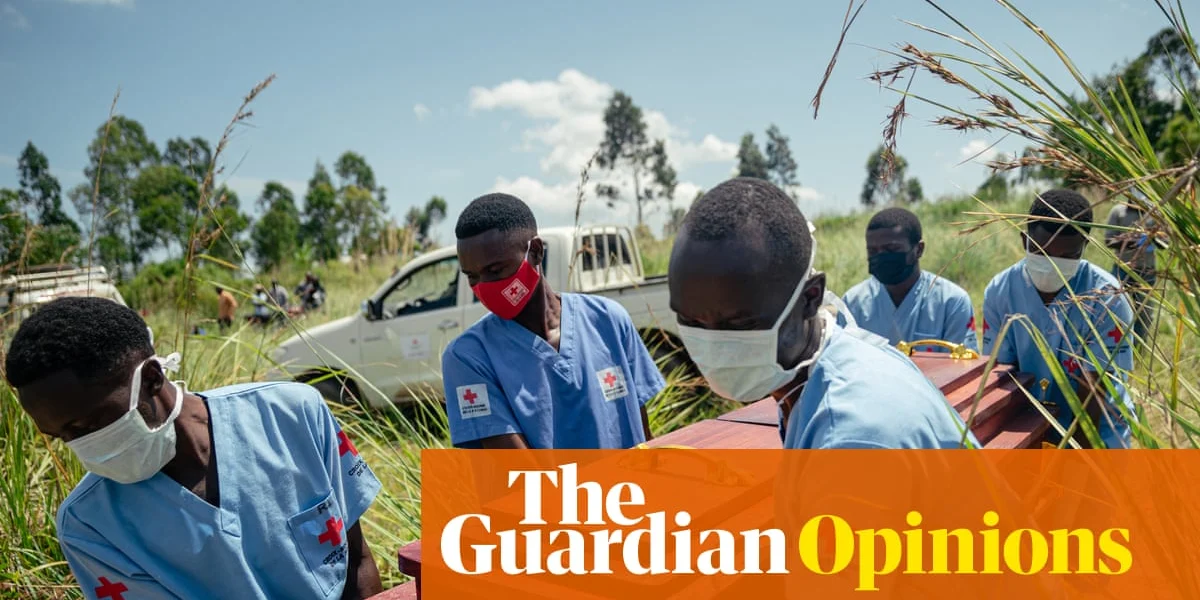
Did you know that there is a major Ebola outbreak in the Democratic Republic of the Congo, and it’s on track to be the deadliest ever? It is already the second-worst Ebola outbreak in history, with the fastest community transmission we have ever seen. It’s estimated that there have been at least 4,900 cases and more than 2,300 deaths, giving a mortality rate close to 50%. The situation is bad. That’s the consensus among global health experts.
Yet this Ebola outbreak isn’t attracting much media or public attention. If I compare it with working on the 2014 Ebola outbreak, the current silence is astounding. That year, Ebola was one of the most Googled terms in the world, covered regularly on broadcast news in many countries outside the region, attracting newspaper headlines and magazine covers. Perhaps everyone is just tired of disease after the pandemic – Covid-19 fatigue, as it’s called. Trust me, no one wants to hear about infectious diseases.
Read more:Ebola: New trial to test treatments for unchallenged viral strain
Unfortunately things are only getting worse in the region. A perfect storm of factors is making the spread hard to contain, even more difficult to slow down – and the health impact is devastating. One concerning factor is that most of the cases, and deaths, are happening in the community before patients even get to hospital: it’s estimated that local health workers are reaching only 30% of cases. Adding to the impact, children make up a quarter of confirmed cases, and almost a third of all deaths. And those are just the direct deaths from the Ebola virus: routine health services such as childhood vaccination campaigns against measles and basic child survival interventions have been disrupted, meaning a higher number of indirect deaths from lack of healthcare.
It’s not just children. Maternal deaths in Ituri (the worst-hit province) have doubled, from childbirth complications and a lack of trained health personnel but also because Ebola infection during pregnancy is linked to foetal loss.
Read more:Why America is failing its health report card | Robert B Shpiner | The Guardian
Why is it proving so difficult to stop? First, there’s the virus itself. The outbreak was of a new species – Bundibugyo – and we don’t have an effective vaccine or antiviral against it. Previous outbreaks were the Zaire species. In addition, viral mutation has been suggested as a factor behind why this outbreak is growing faster than efforts to stop it. Mutation could have made this species more transmissible, as community spread is large and faster than before.
The location of the outbreak is also difficult: Ituri province is unstable, with roaming militias and ongoing conflict. Before it was confirmed as Ebola, it looks as if the virus had been spreading for three months, being misdiagnosed as malaria or typhoid. Effective government and safe living conditions are a prerequisite for health security, and both are missing right now.
Read more:Weight loss from obesity drugs may not lead to broader health benefits
There are also larger global changes that make a coordinated response challenging. In the 2014 west Africa outbreak, the US, UK and French governments worked with the World Health Organization (WHO) to escalate a response, bringing military-like coordination, necessary resources, logistics and trained personnel. An Ebola commission I co-chaired soon after looked at some of the scientific lessons for the WHO health emergencies response, but we couldn’t predict what the next decade would bring politically.
We’ve had two “America-First” Trump presidencies. The US is no longer part of the WHO or working multilaterally, favouring a “go-it-alone” response. This is in the context of the defunding of foreign aid, the censorship of scientists, the closure of USAID, the implosion of the Centers for Disease Control and Prevention, and a “make America healthy again” movement focused on press-ups and visits to the sauna over core public health.
Read more:Alzheimer’s: Modern blood thinners linked to slower cognitive decline
Britain has also stepped back from its responsibilities, cutting foreign aid. It makes sense that the current prime minister, Andy Burnham, is focused on domestic issues: when health inequalities and rising poverty mean British children are some of the unhealthiest in western Europe, it’s tricky politically to divert resources overseas. But those political choices have consequences for countries left with fewer resources to fight the spread of disease.
In a dire situation, a ray of hope is the vaccine and antiviral work under way. Using the same technology as the Oxford-AstraZeneca Covid vaccine, Oxford University has started human trials of the Bundibugyo vaccine, while the WHO is sponsoring a clinical trial in the DRC on two existing antiviral therapies. It’s not just lab science. Social science and the humanities have been engaged to understand how to reach people in remote communities and how to build trust in public health campaigns: given the history of colonial health interventions and residents being used as “guinea pigs”, any health response must understand why people are fearful of external “help”.
Read more:John Gotti’s grandson kept trying to delay prison to donate kidney to mother. A judge said enough.
Budget cuts to higher education have also been consequential. Outbreaks such as this one demonstrate yet again why knowledge, education and research matter, and why political decisions taken in one part of the world have major ramifications for the lives of those in another.