
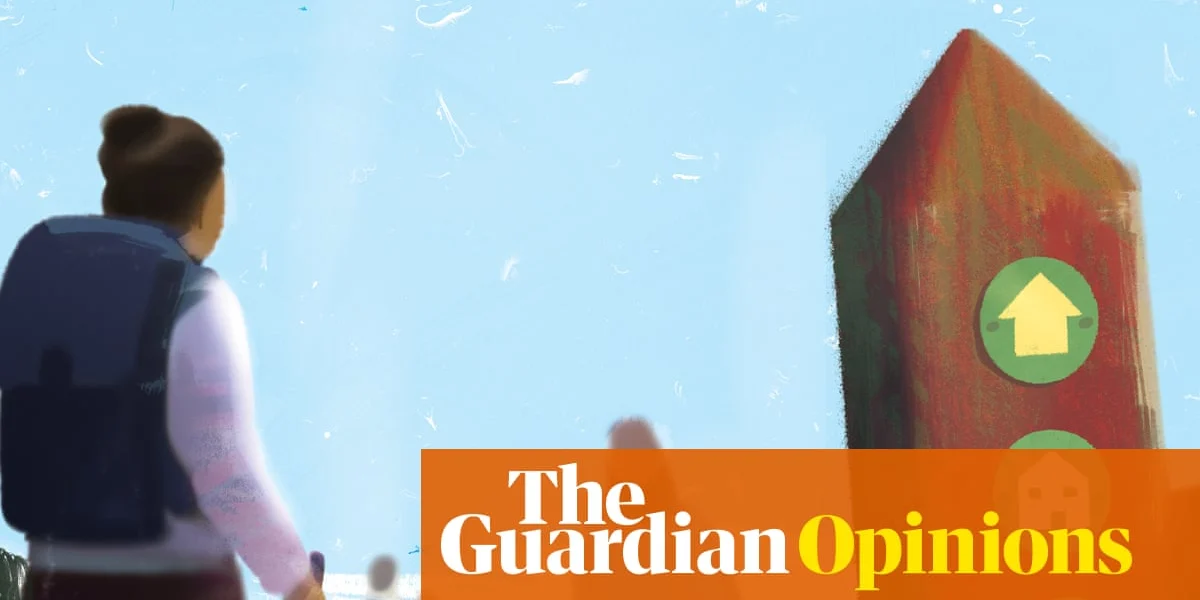
A fortnight or so ago, my two teenage kids and I set out on a three-night visit to the Peak District where temperatures were hovering at a comparatively tepid 28C. We stayed at a youth hostel – more of which in a moment – and began the trip with the 20-minute ascent of Mam Tor, a modest peak that pulls in both dedicated ramblers who then yomp along the ridge beyond, and newbies who mostly want to get to the top and immerse themselves in the jaw-dropping view.
The next bit might sound self-parodically Guardian-esque, but what the hell: in its own way, the most striking sight was the diversity of the scores of people rambling up, down and along. Women in their 20s wearing hijabs picnicked on giant rocks, while multiracial gaggles of young men attempted to race to the top; solo and shirtless white fitness freaks and retirement-age dog walkers took their places alongside them. With plenty of justification, country walking has long been typified as one of the most monoculturally white pursuits there is. But here – presumably because of the relatively close proximity of Manchester and Sheffield – things looked different.
The scenes didn’t quite suggest Britain in microcosm, but they weren’t far off. I began to wonder, in fact, whether I was witnessing the (extremely) belated next emancipatory phase of a story that began with the mass trespass at the nearby Kinder Scout in 1932, led by the Jewish anti-fascist Benny Rothman: the protest in which hundreds of men and women defied the law to walk on privately owned Derbyshire hills and moorland. Five of them received prison sentences, but the way was thereby opened to the creation of the UK’s first national parks.
Read more:Michael Carrick: ‘Ridiculous’ to claim Man United lack passion
The latter-day people and organisations working to make walking more inclusive – in response to national statistics that remain depressing, and often in the face of straight-up prejudice – surely deserve as much praise as Rothman and his comrades. Black Girls Hike was founded in 2019 by the brilliant Mancunian Rhiane Fatinikun, aimed at creating “a safe space for Black women to explore the outdoors … challenging the status quo”. Soon after, the Coventry-based rambler Haroon Mota started Muslim Hikers, and began group walks just over a year later. In the same city, Cherelle Harding created Steppers UK, intended to “normalise black and brown faces in outdoor spaces and create a community of outdoor enthusiasts”.
All this reflects aspects of our culture and politics that can be fascinating and inspiring – and, on the other side of some modern political and cultural divides, very unsettling. If he were to visit the Peak District, Nigel Farage would presumably get no further than his chosen pub. But his vision of bucolic England is symbolised by the outfit he tends to wear when he wants to accuse the supposed metropolitan elite of neglecting the countryside, usually by turning up at one of those faux – or not so faux – fox hunts. We all know the drill: flat cap, Barbour jacket, wellies, fag and pint. The cosplay is replete with meaning, and not just in its embodiment of what a cultural-studies specialist might call white rurality. Look, for example, at the terrible twist Farage and his political allies got their collective knickers in over the National Trust’s drive to be open about some of its properties’ links to colonialism and slavery, and the same organisation’s campaigning to protect the environment.
Further to the right, somewhere in the heart of every nativist lurk darkly romanticised visions of the British landscape – think of what is meant by that toxic phrase “blood and soil”. Last year, news broke about two wooded stretches of land in mid-Wales being bought by the Woodlander Initiative, a scheme led by the far-right activist Simon Birkett. He has links to Patriotic Alternative, reckoned to be the UK’s largest fascist organisation. The people involved were never going to be interested in urban land: to the fascist mind, the countryside, as opposed to the cosmopolitan and decadent stereotypical city (think about the far right’s constant demonisation of London), represents notions of racial purity and noble simplicity. From some far-right activists, there was sympathetic talk in response about “indigenous heartlands – places for our people”.
The upshot of all this is obvious: the UK’s rural expanses can be as toxified and contested as any other aspect of our national life, and without wanting to sound too dour – walking is meant to be fun, after all – we need to actively promote the idea that the countryside belongs to all of us. To do so is to deprive the assortment of opportunists and hate-mongers who span the hard and far right of any idea that the British landscape and its romance and mythology might be theirs to monopolise.
Read more:Michael Carrick: Man United should not panic after humbling Hull defeat
There is another, much more benign and everyday obstacle to maximising access to green spaces. In many places, hotels and hospitality increasingly embody a different kind of exclusivity: the upgrading of pubs and hotels to boutique, gastro-centric establishments with sky-high prices. Those charged on such platforms as Airbnb are part of the same problem. So if your ambitions extend further than a day trip and such luxury is beyond your budget, where can you stay?
Part of the answer lies with the Youth Hostels Association (YHA) of England and Wales (the equivalent north of the border is Hostelling Scotland) and its network of places to eat, sleep and socialise. But the pandemic caused the YHA an income loss of £40m in the first year alone, and in March last year, it said that its energy costs had quadrupled. In 2023, it had about 150 hostels; to date, it has announced the sale or closure of 29. Eight are now run as hostels thanks to a YHA franchising scheme, and there are similar hopes for at least one of my threatened favourites: Bellever on Dartmoor, one of the most idyllic places I have ever spent the night.
But here is the crucial point: the YHA runs a programme that provides fully or “partly funded stays at youth hostels for young people and families facing significant challenges” (including young carers, and those involved in refugee and migrant groups), and a scheme called No Child Left Behind that helps to ensure that financial hardship does not stop kids going on residential school trips. It is an organisation that should be expanding, not shrinking.
Having come down off Mam Tor, I drove the half hour back to where we were staying: Hartington Hall, a 17th-century manor house owned and run by the YHA. As we were having dinner, I noticed a plaque fixed to the wall, presumably dating from the distant days (the YHA was founded in 1930) when guests were obliged to muck in with the chores rather than sample the £14 burger-and-beer meal deal. “This youth hostel,” it said, “is one of many, both in this country and abroad, where young people, regardless of race or creed, may spend the night. The buildings are diverse in character but they have a common purpose: to help all, especially young people of limited means, to a greater knowledge, love and care for the countryside.”
How, then, to preserve as many hostels as possible, bring in more young people and make those words real? An injection of cash from big-spending philanthropists? A modest tourist tax on hotels and short-let accommodation? Or the kind of relative loose change that could presumably be found by the departments for Food and Rural Affairs, Education, Culture, Media and Sport, or all three? Some parts of the British landscape are starting to undergo what seems to be an overdue and very welcome social change, but it needs the kind of support that comes in the form of bunk-beds and brickwork. In a country whose divisions are constantly inflamed and hyped up by demagogic chancers, that challenge is a lot more urgent than it might seem.