

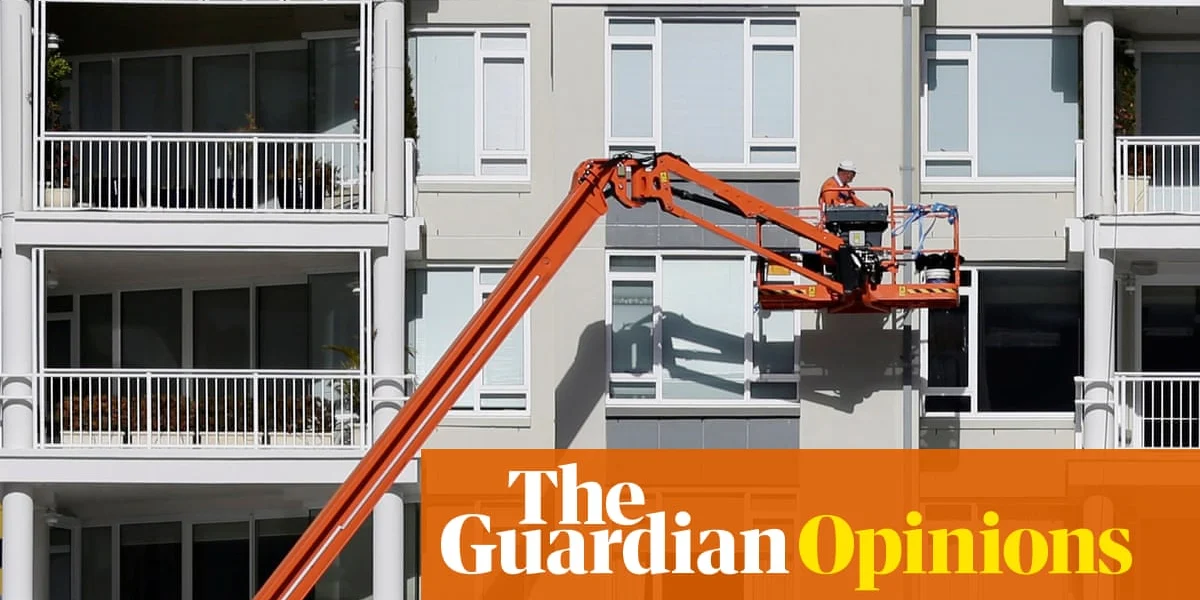
If Australia is to have a population of 40 million in a few decades, as the intergenerational report predicts, adequate housing will be crucial.
Already the system is failing, housing insecurity is rife in one of the richest countries on the planet. The number of public and community houses in New South Wales alone fell by 4,530 over the past three years.
The platitudes of the National Urban Policy, promising sustainable, inclusive growth, affordability and environmental protection, are a poor placeholder for what is needed now, and more so as the economy is restructured by artificial intelligence.
The housing crisis has dominated public discussion for years – affordability is the buzzword and 1.2m new dwellings by 2030 the target.
In response the NSW government last year developed a proposal to allow six- and eight-storey apartment buildings to be constructed around a new railway station at Woollahra in Sydney’s east. As its other mega housing projects collapsed, it put Woollahra on steroids: the suburb’s population should grow by a more than a third.
It could lead to private developers acquiring and demolishing up to 151 heritage buildings and countless trees, in one of Australia’s original garden suburbs, and build 9,400 new apartments in 142 towers, some up to 30-stories high, despite the longstanding NSW Department of Planning mandate for the “retention and integration of local heritage items into the surrounding areas”.
The government will contribute rezoning, a railway station, but no new schools or parks.
This came home to me last weekend, when I discovered that my modest art deco building was designated to become a 9-storey tower.
Part of the charm of Woollahra is that it embodies what town planners used to aspire to, “mixed neighbourhoods” with good public transport. It is mixed in terms of architecture and people.
My 1930s building has district (not harbour) views; its apartments sell for around $1m, making them relatively affordable in the inflated Sydney market. It is home to old ladies who happily keep fit by walking up the stairs, single parents whose children go to the excellent local (public) school, and young people with ordinary jobs.
Read more:Gavin Bazunu confirms withdrawal from Republic of Ireland matches against Israel
The street includes several 3-storey redbrick flats, seven federation houses, 10 terraces, two squillion dollar mansions, an old folk’s home and apartments, a big house subdivided into flats and a run-down 19th-century mansion that hides behind enormous trees.
They are now all overlooked by a new luxury development in Bondi Junction that keeps getting taller thanks to the inclusion of a few “affordable” apartments.
The state government’s plan will transform the three-storey red brick buildings into nine-storey towers, demolish five federation houses and replace them with 12-storey towers, bookended by a couple of heritage properties.
There will be nothing “affordable” about any of them.
Read more:We’re not in a new Gilded Age in America: inequality is now far worse | Casey Michel | The Guardian
The old developers’ rule of thumb: one-third land costs, one-third construction and one-third profit, means an “affordable” apartment will cost $3m, well beyond the means of the people in my building.
Heritage is being demolished all over Sydney, Melbourne and Brisbane; as those Michael Leunig called the awfullisers “trash public places and favourite things”.
There is a need to build more genuinely affordable dwellings, but to do it wisely without destroying the social fabric.
Getting the mix right is key.
Robust public housing commissions once built homes at scale. Because of the large number of dwellings they constructed they employed and trained scores of apprentices. They had the scale to innovate, the way that small builders cannot. Costs were kept down by purchasing power, using publicly owned land and removing the need for profit.
When the federal government in 1995 moved away from giving the states money to build public housing and switched instead to rental support, construction plummeted. For most of the postwar years public housing accounted for about 20% of new dwellings, now it is less than 2%.
Read more:Mexico launches antitrust probe over pro/rel, monopolies in game
The aim at the time was to give “the rental poor” more choice than inadequately managed state housing commission homes. Critics were sceptical, predicting state housing agencies would give up and expensive taxpayer subsidies would help developers more than tenants.
And so it came to pass. We are now in a housing crisis, and without a meaningful urban policy and a fragile construction industry.
This is the product of political decisions, urged on by developers and bankers, for decades.
At one level, proposals like Woollahra feel performative, that nothing will actually happen. Despite the bamboozlingly big numbers of the housing accord, targets are not being met, builders are going broke as costs rise – 3,472 construction companies last year – and the shortage of skilled workers is spinning the divisive immigration debate.
In April the Planning Institute of Australia produced an outstanding paper Growing Well, urging a more serious discussion about housing and types of cities needed to accommodate 14 million more people at a time when AI threatens to pummel the current city-based workforce.
Do we want mega cities, it asked. Or accessible and congenial satellite cities that orbit the state capitals. Or regional developments that follow a fast rail network and allow medium-sized cities to grow across the country, as happens in most other developed societies.
That is the serious conversation we need to have. It needs to produce real, livable, solutions, not just platitudes, profits and towers.