

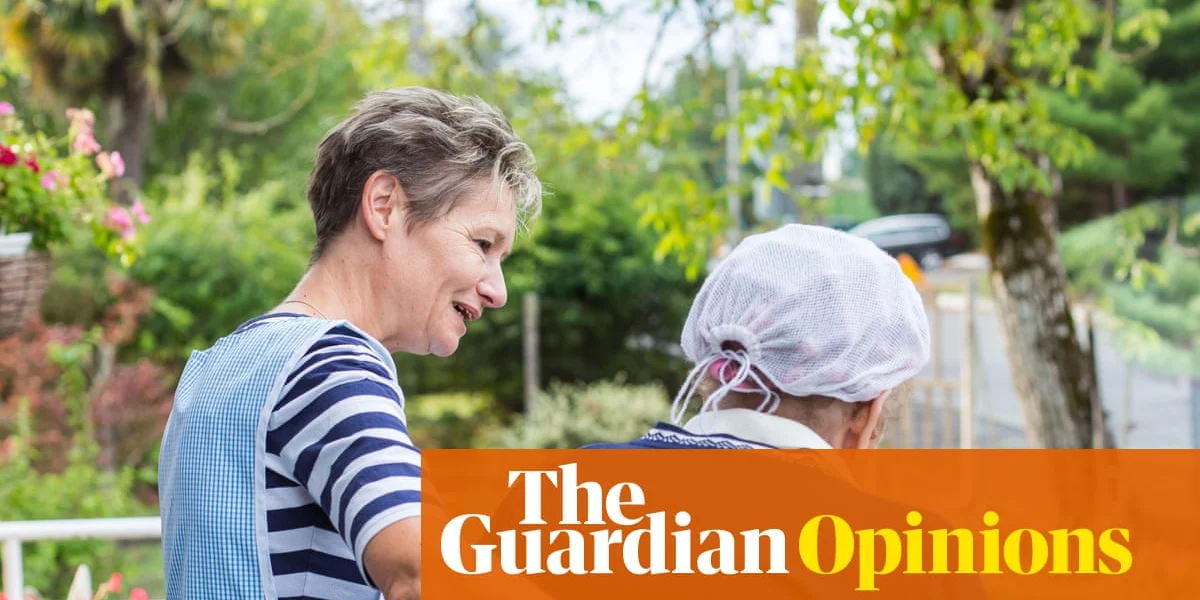
Lisa* has used her local glazier so many times that he gives her a discount. For months, when care workers arrived at her mum’s home, they would find the front door locked and the elderly woman – who has dementia – resolute in her determination to bar their entry. Often, the only solution was to break the glass in the front door. When I met Lisa, who was a participant in a research project I ran, her mother had finally accepted help, but it had taken years of frustration and smashed glass. Unlike Lisa, Lily* never got to acceptance. After two years spent trying to persuade her elderly father to accept social care, she lied. He thinks the people who visit twice a day are nurses, legally required to dispense his dementia medication.
Experiences like these are common among people caring for ageing parents. They present an uncomfortable challenge for those who, like our new prime minister, Andy Burnham, wish to fix our care system. Many people are like Lisa and Lily: they are providing eldercare notbecause of the lack of social care, but because their ageing relatives will not accept external help, or at least not without a years-long fight.
Read more:NWSL set for earliest ever start next season to accomodate World Cup
Numerous studies have shown that people with dementia are prone to refuse medical and wider forms of care. More broadly, we know that people’s preferences for treatment shift over time and as their conditions change: what your loved one thinks they’ll want in the future isn’t necessarily what they’ll accept when that future comes. There is a lag between ageing parents developing care needs and accepting external forms of help, and it’s in that lag that family members step in. There isn’t enough formal evidence of this problem – too few studies ask whypeople receive the type of care they do, rather than assume it’s due to absent alternatives. But in one of the few studies to pose this question, published in the Journal of Nursing Management in 2007, “frail older people” attributed their reluctance to their fear of losing independence, and the humiliation and embarrassment they felt at the idea of being deemed needy.
It is an understandable fear. In our culture, we vilify vulnerability and valorise independence. You only need to look around at the paltry nods to accessibility in our public spaces or the degrading assessments of people seeking to claim disability benefits. For people who have lived their lives independently and able-bodied, the slip into dependency can be hard to accept. This is why Lily’s father finds nurses more tolerable than care workers: he doesn’t want to need care, but medicine – with its connotations of formalisation and expertise – is more acceptable. My mother was the same; after a lifetime being able-bodied, cancer took her mobility. But the notion of a rota of workers trooping into her home was unconscionable; they would be a physical affirmation of her frailty. Nobody wants to need care, so why are we assuming everyone will take it up?
Read more:Slowing aging: Could going to theaters, museums keep the body younger?
There are more granular reasons for refusal too. In the same research in which I worked with Lisa and Lily, Malik*, a British Muslim, explained why his family would not use external care: “It’s a cultural thing, it’s also a religious thing … responsibility for the parents just lives within the family.” Numerous reports have shown that Black and minority ethnic people are less likely to use formal services – this appears to be partly because of community norms that locate responsibility for care within the family, and also because services may lack culturally appropriate options. And lest we forget, the state is not considered a friend by all: past experiences of discrimination may reduce the uptake of services.
Last year, I raised this issue at an event packed with thinktankers and policy advisers working to fix our care system. In response, an attender asked, “What’s the risk of saying this?” She meant that talking about refusal of social care risks undermining the political case for its improvement. We may inadvertently strengthen rightwing arguments that care is a familial concern (by which they mean female family members should do it all for free), rather than something to be funded by government. In contrast, the political left locates care as a state responsibility, transferring it into the paid labour market (albeit still usually performed by women, for almost-free).
My heart sank as the people around her concurred – the prevailing feeling in the room was that good progressives should not talk about this problem in case we undermine long-fought campaigns to make social care a political priority. And, of course, many thousands of people areabsolutely desperate for adult social care – according to the Association of Directors of Adult Social Services, at least 400,000 people are on waiting lists in England alone. But I saw in my mind the innumerable family carers I have met like Lisa, Lily and Malik. I saw the carers’ groups in which people have talked of their loved ones’ refusals. What does it mean if we allow political discomfort to get in the way of truth? And the truth of eldercare is that ageing parents will often refuse support even when they need it, at least for a while.
Read more:Fulham sign Gonzalo García from Real Madrid
There is some evidence that improving social care is actually part of the solution to its refusal: a study examining preferences in countries in the OECD found that “older adults in countries with greater national expenditure on old age support … showed a stronger preference for formal care”. Nobody wants to deal with bad service, and social care is no different. This bodes well, but alone it will not be enough. We need to undo people’s view of dependency as a source of shame. This requires a culture shift. I don’t know how we achieve it, but centring the principles of the disability justice movement is a good place to start. This movement has worked indefatigably to show that people are worthy beyond their productivity, and that interdependence is a fundamental of existence rather than a personal failing. Too few of us have imbibed this wisdom, and the consequences are being played out in households everywhere; we must change that for future generations.
Read more:What should replace the American-led world order? | Aslı Bâli and Samuel Moyn | The Guardian
Culture change takes time, time in which thousands of people like Lisa will continue to struggle with their ageing relatives’ refusals of support. Any realistic package of reforms must acknowledge this situation, providing improved rights and resources for family carers alongside reforms to social care. Time will tell if the government will face this reality, or whether some things remain too inconvenient to acknowledge.