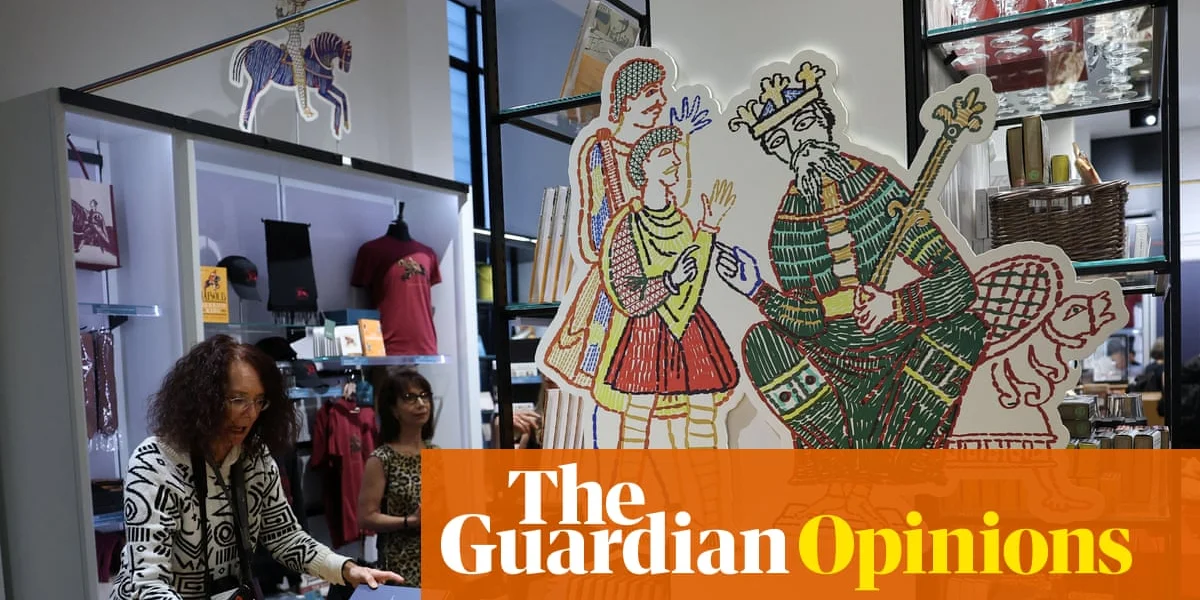
I have seen the Bayeux tapestry four times since childhood, and loved it on each viewing, for the sheer miracle of its survival and the glorious vividness of its detail. But the fourth time, earlier this week, was different – how could it not be?
Tapestrymania has taken hold in London. The textile has been proffered as a diplomatic symbol, the occasion for crowned heads and presidents to mingle and speechify. And, assuming you agree that it was embroidered in England by Englishwomen’s hands (since many scholars argue it was likely stitched in Canterburyrather than Bayeux, Normandy – the tapestry’s home),it is charged with the potency of return, rather than simply of arrival.
If you want to see the Bayeux tapestry at the British Museum, be alert for the next ticket release in October, be resigned to sitting in a long digital queue and be ready to hand over £33. Or, perhaps more realistically, be prepared for disappointment. Viewing times are restricted to protect its delicate fibres from damage, so they can’t simply be extended beyond normal hours. Demand will outstrip supply.
Read more:Inter Miami’s Mateo Silvetti has season-ending shoulder surgery
We see celebrated artworks through the lens of our own historical moment, our own biography. Encountering the tapestry again this week, in a time of war, it seemed impossible to observe the violence of the battles it depicts without a cold dread: the decapitated trunks, the horses clashing and tumbling, the looters stripping the killed of their arms and armour. But what really struck me was how legible the artwork is. Across nearly 1,000 years, its narrative clarity is such that, in its temporary gallery, you barely need to glance up at the British Museum’s animated interpretation. All it asks of you is to look, and the story will lay itself out generously before you.
As a child, on a school trip to Bayeux, I was encouraged to see the tapestry as a cartoon strip. That makes sense, of course, to a child, and cartoonists of recent times have often used the tapestry to riff on. In his cover for the post D-day, 15 July 1944 edition of the New Yorker, Rea Irvin lovingly parodied the tapestry, putting “George Rex” on his throne instead of Edward the Confessor and depicting landing vessels stuffed with GIs, rather than wooden ships filled with Norman troops. It was irresistible in its neat reversal: Normandy invaded from England rather than vice versa.
Read more:Rafa Marquez ready to take Mexico to ‘another level’ as coach
Now, though, I’d rather see it as a visual poem. An epic of conquest. In the wake of that other recent cultural sensation, Christopher Nolan’s The Odyssey, you do not need to be a classics nerd like me (and Mary Beard and I will make a podcast on the tapestry through a classical lens soon) to spot the resonances with ancient epic. The voyaging, the misadventures, the landing on an unfamiliar shore to be met by hostile inhabitants – and then the battle.
One of the most satisfying elements of the tapestry is its pacing, which also has the feel of epic. The relatively slow buildup, with the scenes of Harold and his English setting out across the sea with falcons on their wrists, and tunics pulled up as they wade out to their boats. The drama of Harold’s capture in northern France, his retrieval by William of Normandy, and Harold’s rescue of men sinking into the quicksand at Mont Saint-Michel. The fateful (but unspecified) oath Harold swears to William. The death of Edward back in Westminster, his weeping wife and Harold’s acclamation as king of England. Finally, the clash of armies and Harold’s death.
Read more:West Ham’s Edson Álvarez denies kidnapping accusation
But – also like an ancient epic – it has its moments of strangeness and humour. The main scenes on the textile are bordered by images of fantastic beasts, but also scenes of everyday life – of people ploughing and scattering seed. A reminder of existences that grind on despite the machinations of kings. It reminds me of how imagery works in ancient epic, where similes do a comparable job of pulling the reader out of the main action into a world of nature and ordinary people doing ordinary things.
Above all, the tapestry resonates with the Aeneid, the origin myth of the Roman empire by the poet Virgil (who died in 19BC), the story of which would certainly have been available to the learned elites of 11th-century northern Europe. Like the Aeneid, the tapestry offers adventures at sea, a decisive battle, a new ruler, all heralded by the arrival of a comet signifying a great reversal. Even the feasting scene – William and his men devouring skewers of meat before the battle – has an epic feel.
Read more:Luis Enrique unfazed as historic PSG winless start deepens
It is, then, an English epic: an origin myth for Norman power in England, a story that everyone, or nearly everyone, educated in the UK knows: 1066, Harold with an arrow in his eye, William the Conqueror. Like the Aeneid, it has surface-level propaganda stitched into it. Quite likely commissioned by William’s half-brother, Odo, in the 1070s, its business is to show viewers the inevitability of the crown’s acquisition by this new Norman king. And, since it began to be part of the British imagination from its rediscovery in the 18th century, it has been so successful at imparting that narrative that hardly anyone has heard of Edgar Ætheling, the figure who had a stronger claim on the English throne than either Harold or William, and is completely absent from the tapestry.
But there is another reason for its extraordinary modern persistence than its sheer narrative force, economy and clarity. Despite its “official” status, an object created at the behest of conquering Normans, it is an incredibly open, and surprisingly even-handed, work of art. It has none of the posturing that blatant propaganda contains. Harold and William are portrayed as equals, with Harold accorded significant moments of valour and virtue – it is far from puffing up William solely as a new but better Julius Caesar who managed to conquer England, unlike Caesar, as his biographer, William of Poitiers, had it. The Latin text of the tapestry is clear but laconic. When we are told that “Harold swears an oath to William”, we are not told the nature of this oath (to support William in his claim to Edward’s crown? But who knows).
Read more:Here’s how the summer box office blew up and Hollywood got its mojo back
The textile is an object whose story is completed by its viewer, which is why it is such a rich and generative artefact. Sometimes that “completion” has been for ill: the Nazis saw it strongly in relation to theories of racial superiority, fascinated by the Normans’ Nordic origins.
And what now? The Bayeux tapestry, back (perhaps!) in England after as much as (perhaps!) 900 years, is just beginning a period of intense and excited scrutiny by a thrilled public. What will be read into those ancient threads? What will we take from it? Whatever emerges, it will almost certainly reveal more about us, now, in the 21st century, than the time in which it was made. The narrative of the tapestry is wonderfully clear. But the story it is telling us is ours to compose.