
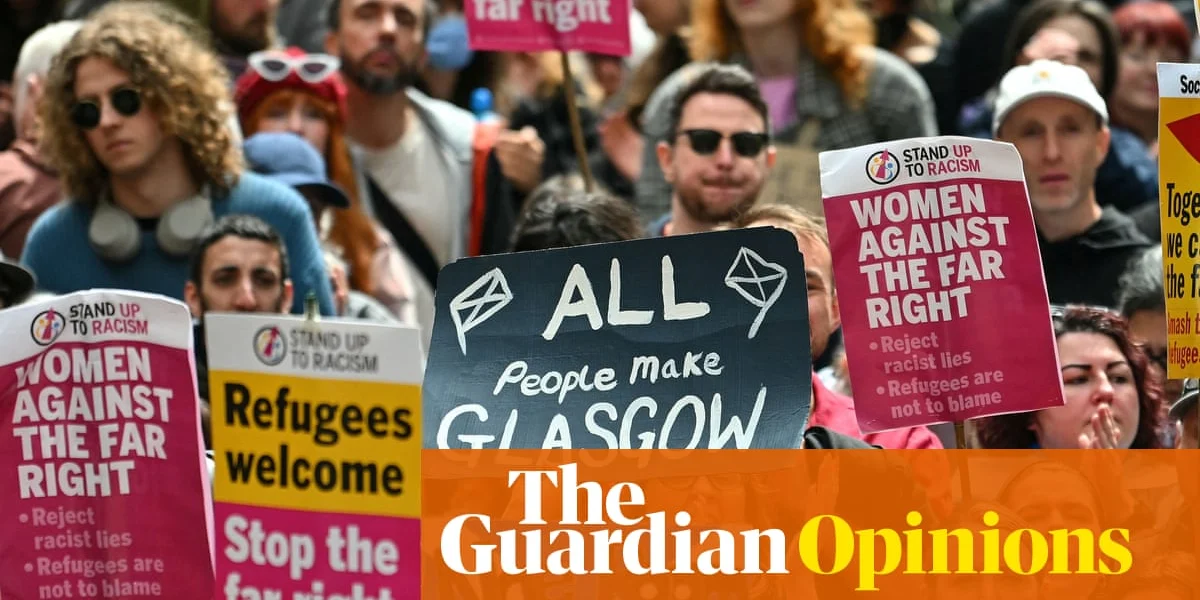
Scottish people have always been known for their friendliness. “We’re not like the south of us,” they say, referring to England. The official slogan of Scotland’s largest city, “People make Glasgow”, appears everywhere – on T-shirts, buildings, bus stops and mugs. And when I first moved to Scotland from India in 2018, I was immediately welcomed by kind strangers and helpful neighbours. People showed curiosity, rather than intrusiveness. They respected queues; told me I fit right in. Music, art and cultural events were considered inclusive spaces in the city, with calls for diversity, creativity, inclusion – all the good things.
As an outsider, this was a dream come true: to be myself, to be alone, to have brotherhood and a community. It was life-changing. I could do whatever I wanted, wear whatever I wanted, walk by myself at night, even. That is a luxury, especially for a woman. But something has changed, particularly after Covid, a global recession and years of austerity. Now, I watch the steady rise of far-right, fringe violence and I feel a special scrutiny upon me.
Read more:Maresca: Man City ‘need different solutions’ after playing Guéhi in midfield vs. Bournemouth
In June, we saw disorder and racists assaults in Glasgow as hundreds of masked protesters marched through the streets. Asian business owners were harassed and people were attacked – according to the police – “because of the colour of their skin”. Later that month, a man was charged with attempted murder after allegedly attacking men leaving a mosque in Edinburgh. A video appeared to show him shouting that he was “protecting the country”. In July, a delivery driver was assaulted after anti-immigration protesters, many of them masked, some shouting racist abuse, once again “rampaged” through Glasgow. We have seen mosques defaced with “hate graffiti” – one is attacked in Britain every five days, according to new data. We’ve heard a speaker at a protest outside an asylum hotel in Falkirk calling for a crowd to “keep Britain white”. There have been activists outside the Scottish parliament staging fascist-style demonstrations. It goes to show top-down propaganda funnels to real-life incidents.
I feel this increasing hostility personally, too. Strangers point-blank question me about my nationality, accent, religion or clothes. A stranger once told me that my accent was weird. Anacquaintance said immigrants were taking away jobs from locals, after I told them I was struggling to find work despite being qualified. People jump queues and are quickly confrontational. The “outsiders” that Glasgow loved and accepted have seemingly become the subject of derision and suspicion.
I find people staring at me, head to toe, for an uncomfortably long time. A customer in a Govan pub casually remarked aloud that immigrants are criminals and that we “need to go back”. An old lady on a bus interrupted me and my very white, very British husband to tell us to stop talking the way we were talking. Was it because we’re clearly an interracial couple? Is it because we categorically don’t sound like the locals? I’ll never know, but it’s gnawing now at the back of my mind when it never would have a few short years ago.
Colleagues who have been here since the 1980s and earlier tell me that racist violence has happened in Scotland before, but this time it feels different. We’re afraid to step out now. There’s a clear, marked shift in our levels of nervousness. It is certainly more imminent, more immediate – closer to home.
I blame a combination of factors for this unsettling change: the high cost of living, the worsening climate crisis and the rightwing agenda of some of the mainstream media have all increased resentment and suspicion of one’s neighbours. Then, during the Covid-19 pandemic, many people felt that they had been left alone. That the state wasn’t taking care of them as a democracy is supposed to do.
Even a global health emergency, it seemed, couldn’t make for a better world. Instead of a fairer, more equal or accessible society, we have extreme wealth inequality that is persistent and increasing. And it doesn’t help that inflammatory posts are favoured by social-media algorithms. All of this creates a tinderbox in which people of colour understandably feel afraid.
Read more:Bonnie Tyler fans line the streets of a Welsh village as her coffin is brought home
Many places, including Leith and Glasgow, held anti-racist, pro-immigrant, pro-humanity rallies days after the racist incidents occurred. People carried signs reading: “Racism is weird, have you tried hobbies?”; “Migrants make the NHS”; “Hate has no home”. They made passionate speeches about standing up to bigotry. But is that enough? While it was heartwarming to see thousands of people come out, uniting for diversity, inclusion and multiculturalism, it won’t stop a growing hatred and fear of people like me. And so every time I’m out in public now, my stress levels go up. Am I safe alone? What is my exit strategy? Can I even afford to be angry? Others feel it, too.
I understand why many British people feel overlooked and badly done by – it’s true that Britain is unequal and unfair. But I wish that the media would not validate people’s inherent biases and misconceptions, nor politicians legitimise their worst sentiments by calling for reactions like “pure, cold rage”. It is easy to whip up hatred between neighbours, but systematic hatred and divisiveness can take decades to undo. The only individuals who benefit from scapegoating are the powerful.
Read more:‘Spider-Man’ tops box office in fourth weekend; ‘The Odyssey’ becomes Nolan’s highest-grossing film
We have to say “no” to this normalisation of bigotry, violence and othering. We have to focus on the living conditions and inequality we all share. We need to remember we have more in common with each other than with any billionaire. We must remember that the real blame lies with the system that wants us divided. Talk to real people who look and sound different from you. You’ll realise we’re all humans. We can do better than this.